
 EN
EN



On December 12, 2025, representatives of the Presidency of the Council of the EU and the European Parliament reached a provisional agreement on regulations governing vehicle design circularity requirements and the management of end-of-life vehicles (ELVs). Hailed as a core pillar of the European Green Deal, this new regulation will thoroughly reshape the development landscape of the EU automotive industry by embedding the concept of circular economy across the entire chain from design and production to end-of-life disposal. It is expected to formally take effect two years after its official adoption in 2027.
I. The Most Notable Breakthrough of the New Regulation: Expanded Regulatory Coverage
Previously, relevant EU regulations only applied to passenger cars and light commercial vehicles. The new rules extend requirements for collection, decontamination, mandatory part removal, and other disposal processes to all conventional heavy-duty vehicles (such as trucks), motorcycles, and special-purpose vehicles (both light and heavy-duty).
However, to balance industry realities, the agreement includes a special exemption for manufacturers of small-batch heavy-duty special-purpose vehicles, retaining necessary flexibility while strengthening supervision. This adjustment means that the vast majority of vehicles on EU roads will be incorporated into the circular economy management system. The significant expansion of coverage will substantially improve resource recovery and utilization rates.
II. Clear Circular Design and Recycled Content Requirements: Core Highlights of the New Regulation
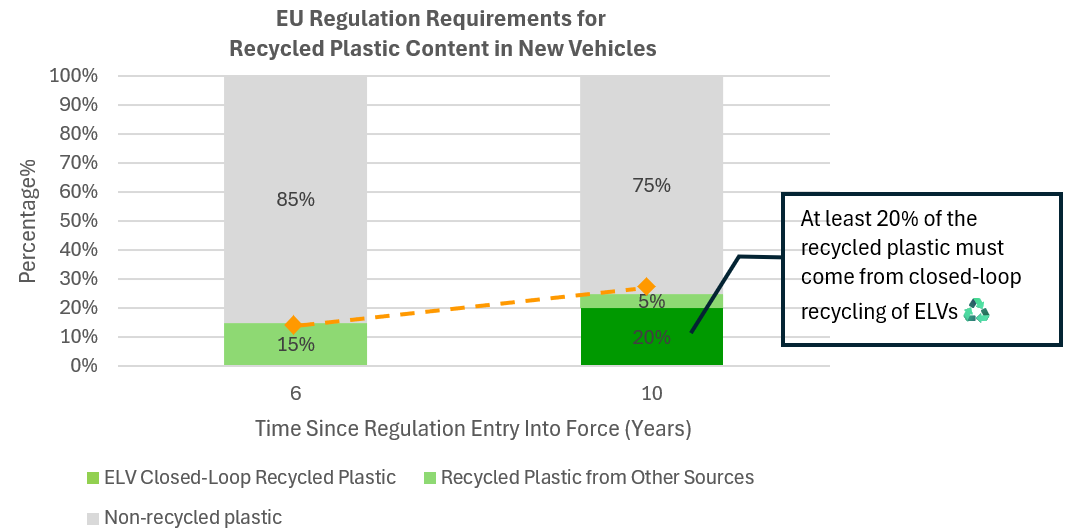
The agreement mandates that new vehicles must be designed to facilitate the recycling, reuse, and remanufacturing of components, addressing dismantling challenges at the source. Regarding recycled content, the phased targets for plastic recycling are particularly noteworthy: within 6 years of the regulation's entry into force, recycled plastics must account for 15% of the materials used in new vehicles; this proportion must rise to 25% within 10 years, with at least 20% of these recycled plastics sourced from the closed-loop recycling of ELVs, ensuring valuable materials remain within the EU economic system.
Additionally, within 1 year of the regulation's entry into force, after completing a feasibility study, the European Commission will set recycling targets for recycled steel, aluminum, magnesium, and critical raw materials, with all targets based on the utilization of post-consumer waste.
III. Strengthened Handling Standards for Used Cars and ELVs
To distinguish between used cars and ELVs, the new regulation strengthens the definition of ELV status and traceability management. It clarifies the criteria for differentiating between used cars and ELVs, aiming to tackle the longstanding issue of approximately 3.5 million EU vehicles going missing, being illegally exported, or improperly dismantled each year.
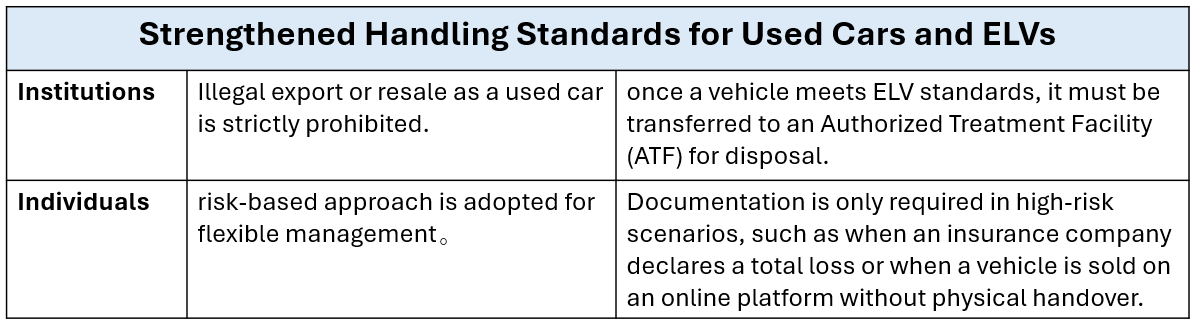
For Institutions: once a vehicle meets ELV standards, it must be transferred to an Authorized Treatment Facility (ATF) for disposal. Illegal export or resale as a used car is strictly prohibited.
For Individuals risk-based approach is adopted for flexible management. Documentation is only required in high-risk scenarios, such as when an insurance company declares a total loss or when a vehicle is sold on an online platform without physical handover.
In terms of ownership transfer, a differentiated management model is implemented: strict supervision applies to institutions, while for individuals, the transfer of used cars or ELVs follows a risk-based principle. Documentation is only required in high-risk scenarios (e.g., total loss declared by insurance companies, online sales without physical handover), preventing risks while avoiding rigid "one-size-fits-all" management.
IIV. Full Strengthening of Extended Producer Responsibility (EPR): Automakers Bear Lifecycle Responsibility
The new regulation requires producers not only to promote the circular design of vehicles but also to ensure the free collection and proper disposal of ELVs, assuming corresponding financial and organizational responsibilities.
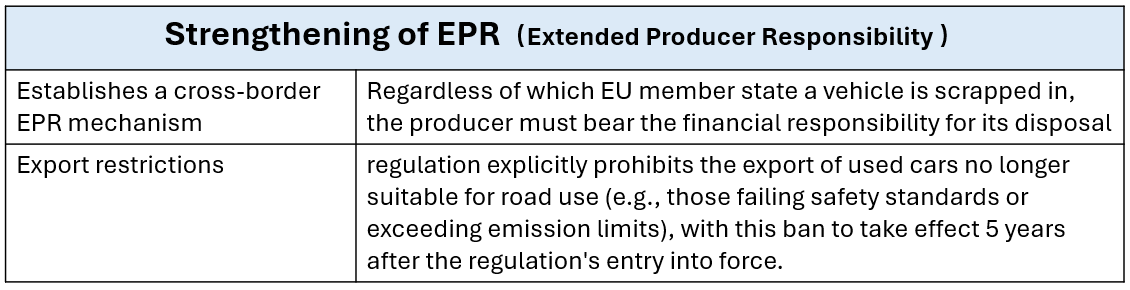
To safeguard the functioning of the EU Single Market, the agreement establishes a cross-border EPR mechanism. Regardless of which EU member state a vehicle is scrapped in, the producer must bear the financial responsibility for its disposal, resolving the institutional issue of responsibility shifting in cross-border scrapping. This mechanism will compel automakers to fully consider recycling needs during the initial product design phase, driving the industry toward green production transformation.
Regarding export restrictions, the new regulation explicitly prohibits the export of used cars no longer suitable for road use (e.g., those failing safety standards or exceeding emission limits), with this ban to take effect 5 years after the regulation's entry into force.
This measure not only fulfills the EU's international commitment to not transferring pollution to third countries but also ensures that valuable materials in ELVs remain in the region, guaranteeing resource supply for the circular economy system.
Data shows that the EU automotive manufacturing industry is resource-intensive, consuming over 7 million tons of steel, approximately 2 million tons of aluminum, and 6 million tons of plastic annually. However, the current utilization rate of recycled materials is relatively low, with plastic recycling at only 19%. The implementation of the new regulation will effectively reverse this situation.
As a key initiative under the EU Circular Economy Action Plan, this new regulation will replace two existing directives, establishing a full-lifecycle vehicle circular management system. Background data indicates that the EU generates over 6 million ELVs each year. While existing regulations have achieved a material recovery rate of approximately 85%, this primarily involves the simple shredding of metal scrap, lacking refined classification and utilization. The implementation of the new regulation will drive the automotive industry's transformation from resource-consuming to circular, reducing environmental pollution, fostering sustainable material supply chains, and creating new green jobs.
Currently, the provisional agreement awaits formal approval by the Council of the EU and the European Parliament. As the 2027 effective date approaches, the EU automotive industry is facing a profound green transformation. For automakers, circular design and the application of recycled materials will become core competencies; for consumers, vehicle scrapping and recycling will be more standardized and transparent. This transformation centered on the circular economy will not only reshape the EU automotive industry ecosystem but also provide a replicable "EU model" for global sustainable vehicle management. Amid the global wave of green transition, this initiative by the EU will undoubtedly have a far-reaching demonstration effect, propelling the automotive industry toward a cleaner and more sustainable future.