
 EN


The BMW N55B30 is a 2,979 cc turbocharged inline-six petrol engine introduced around 2009–2010, depending on the vehicle and market, and used in multiple BMW models through the late 2010s. Developed as the successor to the N54 in many applications, the N55 uses a single twin-scroll turbocharger rather than the N54’s two separate turbochargers. It combines BMW High Precision Injection direct fuel injection with Valvetronic variable valve lift. In the common N55B30M0 version, output is 225 kW (306 PS) and peak torque is 400 Nm, available from approximately 1,200 to 5,000 rpm. Output and engine-management details vary by N55 version and vehicle application.
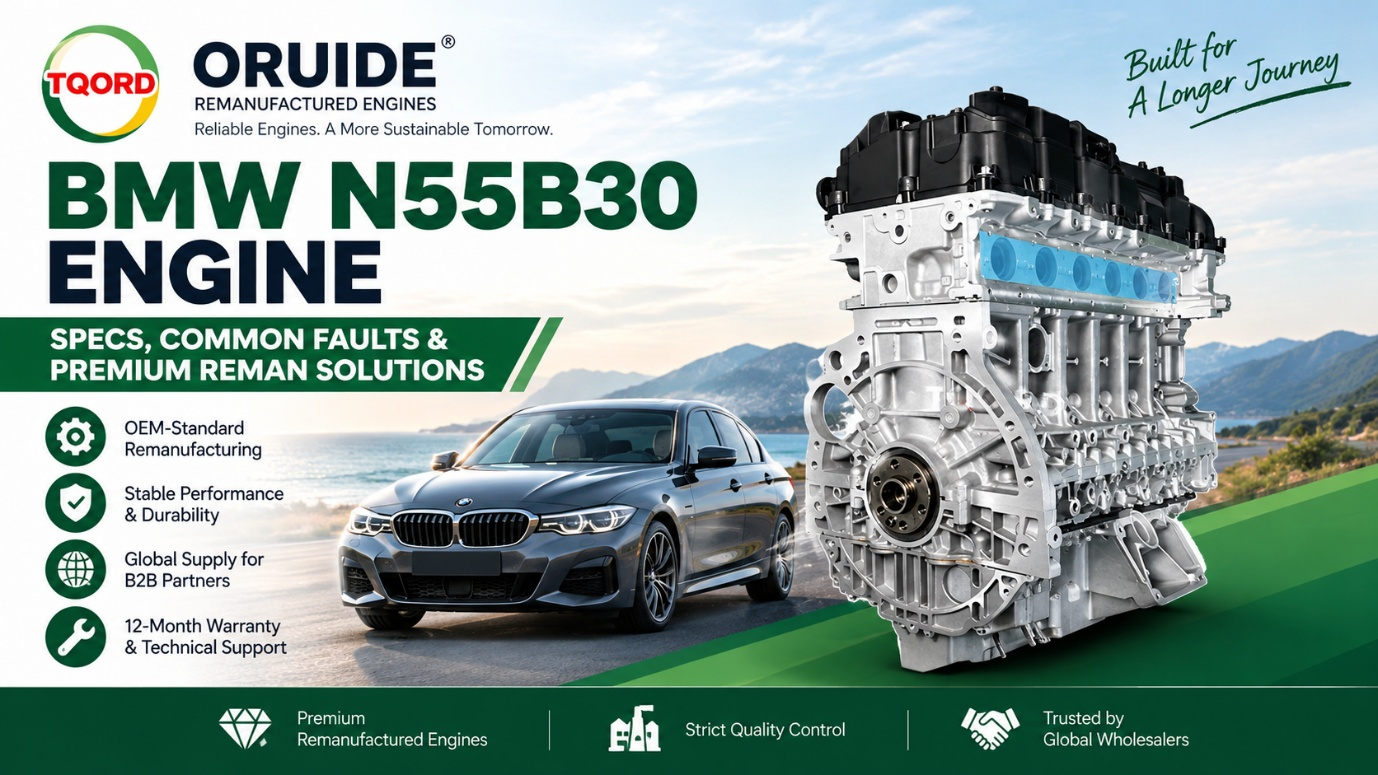
The N55 features an aluminium-alloy crankcase, a DOHC cylinder head and four valves per cylinder (24 valves total). Emissions certification, engine-management hardware and calibration depend on the vehicle’s market and model year, so Euro 5 should not be treated as a universal specification for every N55 application. The engine was fitted to several BMW platforms, including selected 335i, 535i and 640i models. Although the N55 has a strong aftermarket following, ageing vehicles can develop oil leaks, cooling-system faults, Valvetronic issues and turbocharger or boost-system problems. For replacement-engine buyers, the exact engine variant and vehicle fitment must be confirmed before ordering.
For B2B buyers such as auto-parts distributors, workshop groups and engine stockists, sourcing a dependable replacement N55 engine requires careful control of engine variant, core condition and application compatibility. A used engine may have hidden wear, while a low-quality rebuild may not address underlying damage. Oruide supplies remanufactured engines for international aftermarket partners. The remanufacturing scope should be confirmed for each order; inspection findings and the agreed build specification determine which components are reused, renewed or replaced with updated parts.
Core Specifications
Parameter |
Value |
Displacement |
2,979 cc |
Fuel Type |
Petrol / gasoline |
Configuration |
Inline-six, DOHC, 24 valves |
Aspiration |
Single twin-scroll turbocharger (common configuration; confirm exact variant) |
Bore × Stroke |
84.0 mm × 89.6 mm |
Max Power |
225 kW (306 PS) for the N55B30M0 variant; output varies by version |
Max Torque |
400 Nm @ approximately 1,200–5,000 rpm for the N55B30M0 variant |
Fuel System |
High Precision Injection direct injection; engine-management system varies by application (e.g., MEVD17.2 on some versions) |
Emission Standard |
Market- and model-year-dependent; verify vehicle-specific certification |
Compression Ratio |
10.2:1 for the common N55B30M0 specification |
Cooling System |
Liquid-cooled |
Turbocharger |
Single twin-scroll turbocharger; manufacturer/hardware can vary by version |
Timing System |
Timing chain; do not assume a specific chain design or classify the engine as non-interference without variant-specific documentation |
Recommended Oil |
Use the BMW-approved oil specification and viscosity listed for the exact vehicle, market and engine variant |
Engine Weight |
Published weight depends on the definition and engine configuration; confirm from application-specific technical data |
Compatible Vehicle List
Make |
Production Year |
Model |
Variant |
BMW |
2012–2015 (approx.; market-dependent) |
3 Series F30 |
335i |
BMW |
2010–2017 (approx.; market-dependent) |
5 Series F10 |
535i |
BMW |
2011–2018 (approx.; market-dependent) |
6 Series F12 / F13 |
640i |
Important note: N55 engines are available in different technical versions, and vehicle-specific ancillaries, engine management, turbocharger hardware, intake components, cooling connections and mounting arrangements may differ. Do not assume that an engine from one chassis can be installed directly in another. Confirm the VIN, engine code, production date and required ancillary configuration before ordering.
Common N55 Faults & Root Cause Analysis
One commonly reported issue, particularly on some early applications, is high-pressure fuel-pump (HPFP) malfunction. Possible symptoms include extended cranking, difficult starting, reduced power, misfires and fuel-pressure fault codes. These symptoms can have several causes, so diagnosis should confirm actual low- and high-pressure fuel-system performance before the pump is replaced. HPFP design and service history vary by engine version; replacement with a revised part should only be specified after checking the exact application. During remanufacturing, inspect the fuel system as required by the agreed build scope rather than assuming every N55 needs the same pump replacement.
Valvetronic system faults are another potential source of rough idle, reduced power or fault codes. Depending on the vehicle and failure mode, the issue may involve the eccentric-shaft sensor, Valvetronic actuator, eccentric-shaft mechanism, wiring or lubrication condition. Diagnosis should identify the failed component rather than treating the sensor as the cause in every case. Where these components are serviced during remanufacturing, check their condition and complete the required adaptation or calibration procedure for the specific engine-management system.
Turbocharger and boost-control faults can include wastegate or actuator wear, boost leaks and a cracked charge pipe. Symptoms may include rattling, underboost or overboost faults, reduced power and limp-home operation. The exact wastegate system differs across N55 applications. Inspect the turbocharger, actuator/linkage, charge-air pipes and connections, and verify control-system operation using the appropriate vehicle-level diagnostic procedure. Do not describe boost control as validated on a cold engine bench unless the test setup specifically supports that function.
Oil leaks and cooling-system faults are also common age-related service concerns. Check the valve-cover gasket and oil-filter-housing gasket for leaks, as well as the electric water pump, thermostat, coolant hoses and plastic coolant connections for faults or coolant loss. A leak or cooling-system failure can lead to overheating and consequential engine damage if ignored. During remanufacturing, inspect these areas and renew defective seals or components according to condition and the agreed scope; do not assume every vehicle uses the same revised part.
Oruide N55B30 Remanufacturing Workflow
Oruide’s remanufacturing workflow is designed for wholesale orders and international aftermarket partners. The exact scope of work and testing is confirmed against the engine specification and order requirements.
- Full teardown and inspection: The incoming core is disassembled as required. Components are cleaned, measured and inspected against serviceable limits; reusable parts are separated from parts that must be replaced or scrapped.
- Precision machining: Where inspection shows it is required, the cylinder block, cylinder head, crankshaft and connecting rods are measured and machined to the applicable technical tolerances.
- Wear-part renewal: Gaskets, seals, bearings, piston rings, timing components and other parts are renewed according to inspection results and the agreed build specification. Fuel-system, Valvetronic, turbocharger and cooling-system components should be assessed for the exact N55 variant rather than automatically described as replaced on every engine.
- Controlled-torque assembly: Technicians assemble the engine using calibrated tools and the applicable assembly specifications and tightening sequences.
- Cold bench testing: Each completed engine is cold-tested using Oruide’s available test procedure to check the functions supported by the test setup, such as oil pressure and sealing integrity. A cold test does not by itself confirm hot-running performance or prove that the vehicle’s turbo boost control and engine-management systems operate correctly once installed.
- Export-grade packaging: Approved units are secured in packaging suitable for international transport. Packaging and shipment arrangements are agreed according to the destination, transport mode and order requirements.
Oruide supports wholesale enquiries for remanufactured BMW N55 engines from auto-parts distributors, engine stockists and repair networks. For a quotation, provide the VIN, engine code, vehicle model/year and any required ancillary or configuration details so the correct specification can be confirmed. Buyers can also enquire about other remanufactured BMW engine applications and discuss export documentation and shipment arrangements with the sales team.
Q&A
Q1: What is the main difference between the BMW N54 and N55?
A: The N54 uses two separate turbochargers, while the N55 uses a single twin-scroll turbocharger in its common configuration and incorporates Valvetronic variable valve lift. Exact hardware and output depend on the specific engine version. It is not accurate to assume that the N55 is more reliable in every application; maintenance history and component condition matter.
Q2: Can a remanufactured N55 engine be tuned?
A: Some N55 applications have substantial tuning potential, but achievable output and risk depend on the engine variant, calibration, fuel quality and condition of supporting systems. Tuning can increase thermal and mechanical loads and may affect warranty coverage. Confirm the intended use and any tuning requirements with the supplier before ordering.
Q3: Can an N55 engine from an F10 535i be installed directly in an F30 335i?
A: Do not assume it is a direct swap. Engine version, production date, engine-management hardware, ancillaries, intake and cooling connections can differ. Confirm compatibility by VIN and engine code, and establish which components must be transferred or changed before purchase.
Q4: Does Oruide accept wholesale orders of remanufactured N55 engines for export?
A: Oruide handles B2B enquiries for remanufactured engines and can discuss order quantities, specifications, packaging and export documentation. Availability, lead time and shipment arrangements should be confirmed for each order.
Q5: What maintenance advice should be given to end customers after installing a remanufactured N55?
A: Follow the oil specification and service schedule stated for the exact vehicle and engine variant; BMW Longlife approvals and viscosity grades are not universal across all N55 applications. Monitor oil and coolant levels, address leaks promptly, maintain the cooling system and use the correct fuel. Follow the installation and initial-start procedures supplied with the engine.
Ready to source high-quality remanufactured engines from a reliable engine supplier? Fill out our form to get a customized quote within 24 hours. We’ll help you select the right engine model, confirm MOQ, and outline delivery timelines, so you can source with confidence.