
 EN


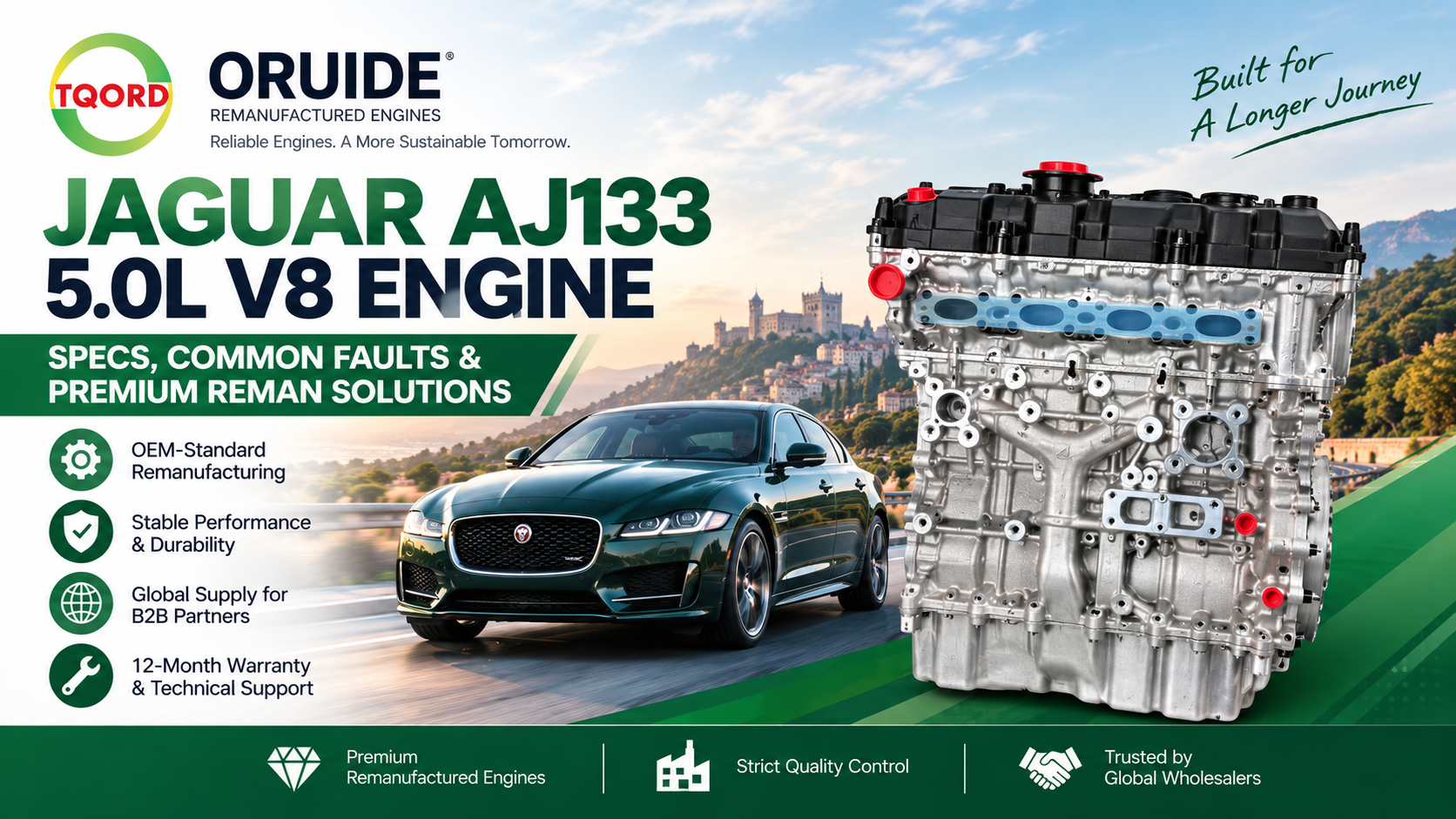
The Jaguar AJ133 is a 5.0-litre V8 petrol engine introduced for Jaguar’s 2009 model-year powertrain range. The family includes both naturally aspirated and supercharged versions, so the exact engine specification must be confirmed before ordering a replacement. This article focuses on the naturally aspirated AJ133 used in selected Jaguar XF, XJ and XK applications.
The naturally aspirated version delivers smooth V8 performance through a high-compression, direct-injection design. It should not be confused with the supercharged AJ133S/AJ133 variants, which use different compression ratios, output levels and supporting hardware.
For automotive wholesalers, regional distributors and professional repair networks, sourcing a suitable replacement AJ133 requires more than matching the displacement. Engine code, vehicle platform, model year, accessories, emissions configuration and VIN all affect compatibility. Professional remanufacturing can offer an alternative to an unverified used engine when core condition and prior service history are uncertain.
AJ133 Technical Specifications
The table below describes a representative naturally aspirated Jaguar AJ133 5.0L V8 configuration. Figures can vary by vehicle, model year and market; verify the exact application against the vehicle’s technical documentation before procurement.
Parameter |
Value |
Displacement |
Approximately 5,000 cc (5.0L; commonly listed as 4,999 cc) |
Fuel type |
Petrol / gasoline |
Fuel system |
Direct gasoline injection |
Configuration |
V8, DOHC, 32 valves; aluminium-alloy block and cylinder heads |
Aspiration |
Naturally aspirated (non-supercharged) |
Bore × stroke |
92.5 mm × 93.0 mm |
Power output |
Representative early NA specification: 385 hp (SAE), approximately 283 kW |
Peak torque |
Representative early NA specification: 515 N·m |
Compression ratio |
11.5:1 for the naturally aspirated version; supercharged versions differ |
Emissions standard |
Market- and model-year-dependent; Euro 5 applies to some early European applications |
Cooling system |
Liquid-cooled |
Turbocharger / supercharger |
No turbocharger or supercharger on the naturally aspirated version |
Timing system |
Chain-driven DOHC with variable camshaft timing |
Engine oil |
Use the Jaguar/Land Rover-approved oil specification for the exact vehicle and model year; 5W-20 is specified for some early applications |
Oil capacity |
Application-dependent; some early service specifications list approximately 7.25 L with filter |
Engine weight |
Varies by configuration and installed accessories; a single universal dry-weight figure is not specified here |
12 months / Customized terms available for qualified B2B orders |
Compatible Vehicles
Naturally aspirated AJ133 engines were fitted to selected versions of the following Jaguar models. Availability and output depend on market, trim and model year:
- Jaguar XF (X250): selected 5.0L V8 naturally aspirated applications, introduced around the 2009 model year.
- Jaguar XJ (X351): selected 5.0L V8 naturally aspirated applications from the 2010 model year, depending on market.
- Jaguar XK (X150): selected 5.0L V8 naturally aspirated applications, approximately 2009–2014.
The supercharged AJ133 variants were also used in higher-output Jaguar models and several Land Rover applications. Those engines should not be treated as interchangeable with the naturally aspirated version simply because they share the AJ133 family name. Confirm the full engine code, VIN, vehicle platform, ancillary equipment and calibration before quoting or shipping.
Common Known Issues & Failure Analysis
As with other high-performance V8 engines, AJ133 condition depends on maintenance history, oil quality, thermal management and operating conditions. The issues below are reported failure areas, not guaranteed defects on every engine.
1. Timing-chain and tensioner wear
Timing-chain, guide or tensioner wear may cause a rattle at cold start or timing-correlation fault codes. Risk varies with engine version, production date and maintenance history; it is not accurate to claim that every unit fails before a fixed mileage. Continued operation with a genuine timing-system fault can cause serious engine damage.
2. Valve-seat or cylinder-head concerns
Valve-seat movement or damage has been reported in some cases but should not be described as a common or universal failure. Compression testing, leak-down testing and cylinder-head inspection can help identify the actual condition when misfire or compression-loss symptoms are present.
3. Direct-injection and intake deposits
The direct-injection fuel system and intake tract can develop deposits or component faults over time. Rough idle, hesitation or reduced response can also result from ignition, sensor, air-leak or fuel-pressure issues, so diagnosis should precede parts replacement.
4. Coolant leaks and overheating
Age-related pipe, hose, seal or heat-exchanger leaks may lead to coolant loss. Any overheating event requires investigation of the cooling system and potential secondary damage; replacing a leaking pipe alone may not address the root cause if overheating has already affected the engine.
At Oruide, remanufacturing focuses on inspecting the condition and likely cause of failure rather than assuming that every engine has the same defect. Depending on the core’s condition and the agreed specification, the process may include timing-system inspection, cylinder-head and valve-seat checks, fuel-system evaluation, and inspection of cooling-system components. Parts are replaced or reconditioned according to inspection results and the applicable technical requirements. Avoiding repeat failures also depends on identifying related vehicle-system issues that may not be supplied with the replacement engine.
Oruide Remanufacturing Workflow
Oruide’s remanufacturing workflow is designed for professional B2B aftermarket supply. The scope of work is determined by the engine variant, core condition and agreed supply specification.
1. Full teardown & inspection
The engine core is disassembled and cleaned. Critical components are inspected for wear, damage and dimensional condition; non-destructive testing is applied where appropriate.
2. Precision machining
The block, cylinder heads, crankshaft and connecting rods are measured and processed where required, subject to material condition and applicable dimensional limits.
3. Wearing-part renewal
Gaskets, seals, bearings, piston rings and timing components are inspected and replaced as required by the remanufacturing specification. Any upgrade is applied only where the correct part and technical basis are confirmed.
4. Controlled assembly
Trained technicians assemble the engine using calibrated tools and defined procedures, checking critical clearances and timing alignment.
5. Cold-test bench validation
Each completed engine undergoes Oruide’s cold-test bench process to check key mechanical and functional parameters available under cold-test conditions, including oil-pressure generation, sealing/leakage and timing synchronization where supported by the test setup. Cold testing does not claim to verify combustion performance under a fired, hot-running condition.
6. Export-grade packaging
After final inspection, engines are protected and packed for international freight according to the shipment requirements.
Oruide supplies remanufactured engines to automotive distributors, wholesalers and professional repair networks. For AJ133 inquiries, we recommend providing the VIN, full engine code and vehicle details so compatibility and quotation can be assessed against the actual application. Availability and price may vary with core availability, specification and order quantity.
You can also explore Oruide’s remanufactured V8 engine range for other Jaguar and Land Rover powertrains.
Frequently Asked Questions
Q1: Is the AJ133 naturally aspirated or supercharged?
The AJ133 family includes naturally aspirated and supercharged variants. This article focuses on the naturally aspirated 5.0L V8. The supercharged versions have different compression ratios, output and supporting hardware, and should be identified separately.
Q2: Can I swap an AJ133 between XF, XJ and XK?
Not automatically. Even where the engine family and displacement match, mountings, accessories, oil-pan configuration, wiring, emissions equipment and calibration may differ. Confirm the complete engine code and VIN before ordering.
Q3: What is the difference between a used AJ133 and an Oruide remanufactured AJ133?
A used engine may retain unknown wear and service-history risks. Oruide remanufacturing includes disassembly, cleaning, component inspection, machining or replacement as required, controlled assembly and cold-test validation. The exact work scope depends on the core and agreed specification.
Q4: Does Oruide support bulk wholesale orders for export?
Oruide supports B2B inquiries from distributors, wholesalers and professional repair networks. Order quantities, lead times, packaging and supply arrangements are assessed according to engine availability and the customer’s requirements.
Q5: What is the typical service life of a remanufactured AJ133?
A single mileage figure cannot be guaranteed. Service life depends on remanufacturing scope, installation quality, oil and coolant specifications, maintenance, operating conditions and the condition of related vehicle systems. Follow the vehicle-specific Jaguar/Land Rover service requirements.