
 EN
EN


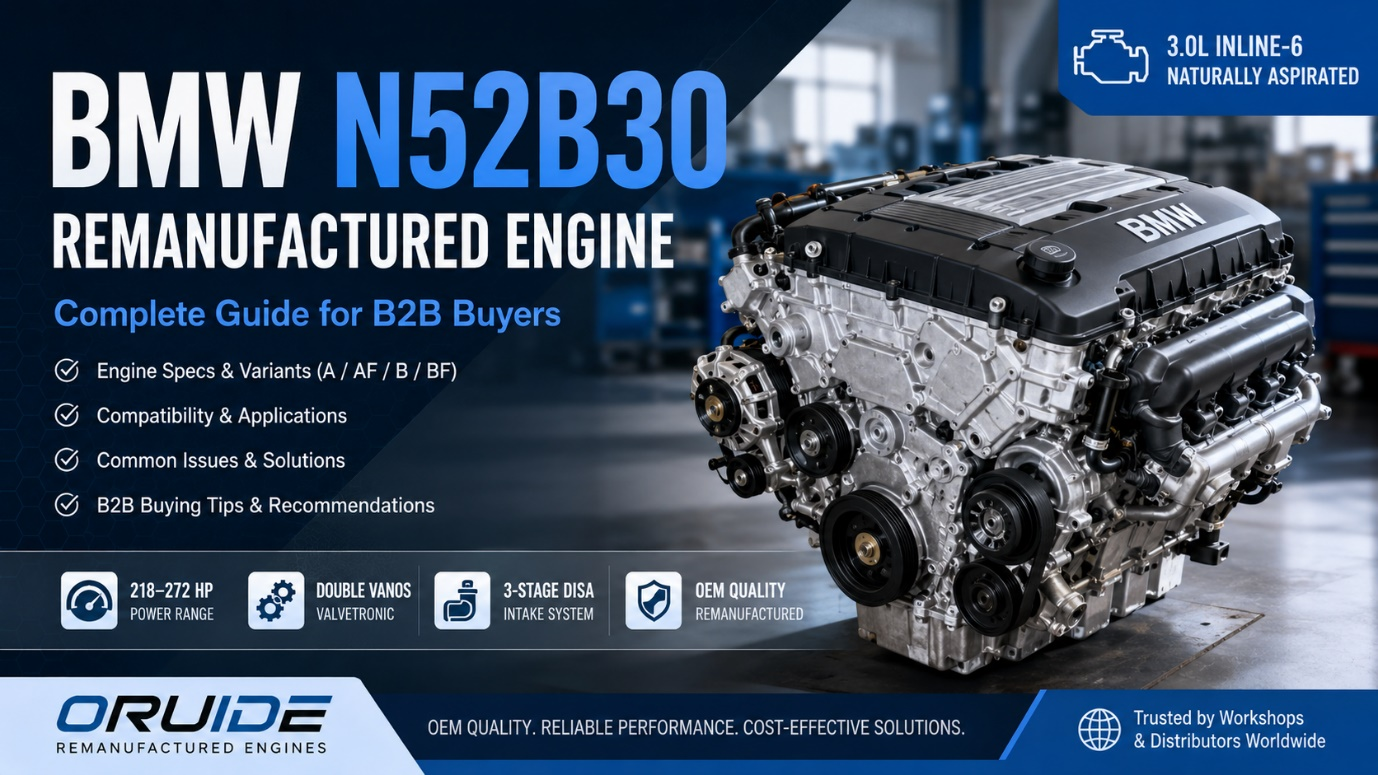
For buyers looking for BMW engines, the N52B30 is one of the most widely used naturally aspirated inline-6 engines in the global aftermarket.
However, in real procurement, especially for workshops, distributors, and parts traders, the challenge is not simply sourcing an N52 engine, but selecting the correct variant and ensuring compatibility.
Overview of BMW N52B30 Engine
The BMW N52B30 is a 3.0L naturally aspirated inline-6 engine (2996cc) produced between 2004 and 2011.
It is considered as one of BMW’s last naturally aspirated inline-6 platforms and the successor to the M54 engine, its specification and character listed as below:
Engine Model |
Rated Horsepower |
Peak Torque |
Intake System |
Target & Compatible Models |
Production Years |
Key Differences |
Main Sales Regions |
N52B30A |
258 hp |
300 N·m |
3-stage DISA |
E90 330i / E60 530i / X5 3.0i Early Chinese-market 30i high-output variants |
2004-2007 |
First-gen high-output, base calibration |
EUR (Europe), EA (East Asia / early China), MEA (Middle East) |
N52B30AF |
272 hp |
315 N·m |
3-stage DISA |
Late-model 330i, 530i, Z4 30i Euro-spec / high-trim variants |
2007-2011 |
A-upgraded version: optimized ECU/timing, Euro 4 emissions compliant |
EUR (primary), EA (late Chinese-market 30i), limited US |
N52B30B |
218 hp |
270 N·m |
1-stage DISA |
E90 325i / E60 525i Mainstream domestic low-output variants |
2004-2007 |
First-gen low-output, simplified intake & power-limited |
EA (China / East Asia primary), limited EUR |
N52B30BF |
231 hp |
270 N·m |
1-stage DISA |
Late-model 328i / 528i North American-spec & late domestic low-output variants |
2007-2011 |
B-upgraded version: optimized emissions & smoothness |
US (North America primary), EA (late Chinese-market 28i), limited EUR |
Key Technical Features
● Aluminum-magnesium alloy engine block (lightweight design)
● Double VANOS (variable valve timing)
● Valvetronic system (variable valve lift)
● 3-stage DISA intake system
● Power Range 218 hp – 272 hp depending on variant
N52B30A (Base High Output Version)
● 258 hp @ 6600rpm / 300 Nm @2500-4000rpm
● 3-stage DISA
● Used in 330i (E90), 530i (E60), X5 3.0si, early mainstream 30i version
N52B30AF (Upgraded Version)- Improved performance + emission optimization
● 265–272 hp / 315 Nm
● ECU optimization and intake improvements
● Used in later 30i models
N52B30B (Low Output Version)- Reduced power + simplified intake system
● 218 hp @6100rpm / 270 Nm@2400-4200rpm
● Single-stage DISA
● Used in 325i / 525i (mainly China / EA markets)
N52B30BF (Revised Low Output Version)- Emission compliance upgrades
● 231 hp / 270 Nm
● Used in later 28i (mainly North America)
Why These Differences Matter in Remanufacturing
From a remanufacturing perspective, these variants are not interchangeable without consideration.
Although they share engine block, crankshaft and core mechanical structure
They still differ in intake system configuration (DISA stages), ECU calibration and emission setup, which means different variants require different remanufacturing processes, component selection, and calibration.
VIN Code vs Engine Variant
For professional buyers, relying only on “N52B30” is not sufficient.
As explained in our VIN guide: VIN determines the exact configuration and compatibility.
So if a buyer select N52B30A instead of AF or B instead of BF.
it may lead to mismatch in ECU, installation issues or emission non-compliance.
Besides VIN. understanding common issues helps B2B buyers evaluate remanufacturing quality.
Typical Problems of N52B30
● Electric water pump failure (usually after 5–8 years)
● Valve cover gasket oil leaks
● VANOS solenoid issues (power loss / unstable idle)
● Oil pan gasket leakage
Additional Observations
● Higher oil consumption in some high-mileage units
● Less prone to carbon buildup compared to turbo engines
These issues are typically addressed during the remanufacturing process through: replacement of wear components, sealing system renewal and system calibration
Why N52B30 Remanufactured Engines Are in Demand
Despite being discontinued, N52 engines remain widely used due to: large installed base, strong reliability and simpler structure compared to turbo engines
This creates stable aftermarket demand, repeat order potential along-term supply opportunities
Procurement Recommendations for B2B Buyers:
For workshops, distributors, and traders:
1.Always Confirm Variant + VIN
Engine code alone is not enough, variant + VIN ensures correct match
2. 2. Choose Suppliers with Remanufacturing Experience
A qualified supplier should be able to:
● Identify variant differences
● Adjust remanufacturing process
● Ensure compatibility
3.Avoid Generic Quotations
Pricing without VIN or variant confirmation is unreliable, because different variants require different parts and cost structure varies.
FAQ
Q.Is N52B30A interchangeable with N52B30AF?
A.Not directly. Differences in ECU and intake system may require adjustments.
Q.Why is VIN important for N52 engines?
A.VIN identifies exact configuration, including emission standard and variant.
Q.Get a Fast Quote
A.Ready to source high-quality remanufactured engines from a reliable engine supplier? Fill out our form to get a customized quote within 24 hours. We’ll help you select the right engine model, confirm MOQ, and outline delivery timelines, so you can source with confidence.