
 EN
EN


For commercial fleets, independent repair workshops, and automotive parts dealers, the Land Rover 204DT engine—officially coded 204DTA represents one of the highest-demand, most frequently serviced powertrains in the premium SUV aftermarket. Produced from 2016 to 2020, this 2.0-liter inline-four turbo diesel belongs to JLR’s first-generation Ingenium engine family, built to replace older Ford-derived diesel units and power popular models including the Range Rover Evoque (L538), Discovery Sport (L550), and early Velar prototypes. As workshop workloads rise and fleet operators prioritize uptime and cost control, understanding this engine’s design, weaknesses, and reliable replacement solutions has become essential for sustainable B2B operations.
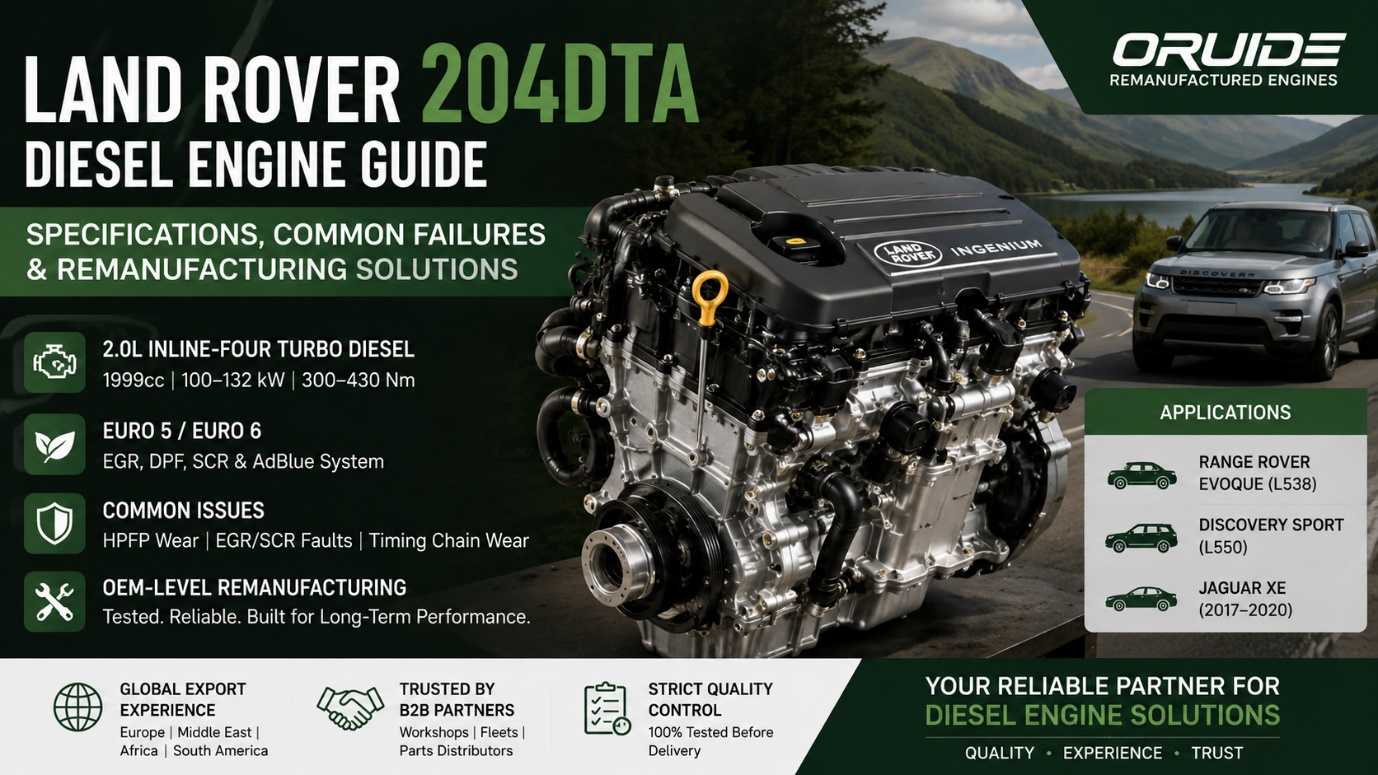
The 204DTA is a 2.0-liter inline-four turbo-diesel engine that served as a core powertrain across Jaguar and Land Rover lineups over two distinct generations, tailored to meet evolving performance, emissions, and platform requirements. Spanning from the early 2010s to the late 2010s, this engine balanced efficiency, torque delivery, and refinement while adapting to increasingly stringent Euro emissions standards.
1.Jaguar 204DTA (2010–2015)
Developed for Jaguar’s executive sedan range, the first iteration of the 204DTA (1,999 cc) was engineered to deliver responsive low-end torque and quiet cruising behavior, making it well-suited for the XF and XJ 2.2D variants.
At its core, the engine features a single variable-geometry turbocharger paired with Bosch CRS 2-20 common-rail direct injection (operating at up to 1,800 bar), enabling precise fuel metering and strong low-RPM pull. Output figures stand at 130 kW (177 PS) at 4,000 rpm and 430 Nm of torque between 1,750–2,500 rpm, balancing fuel economy with the drivability expected of premium executive sedans.
Compliance with Euro 5 emissions standards was achieved through a combination of exhaust gas recirculation (EGR), a diesel particulate filter (DPF), and selective catalytic reduction (SCR) with AdBlue injection. The engine uses a timing chain-driven dual overhead camshaft (DOHC) layout, paired with water cooling and a 16.0:1 compression ratio, with a dry weight of 165 kg.
A notable technical concern documented in Jaguar’s Technical Information Service Bulletin JAG-TIS-4520 is premature high-pressure fuel pump (HPFP) wear, particularly in vehicles operated with low-lubricity diesel fuel. This fault can trigger fuel delivery irregularities and engine stalling. Jaguar addressed the issue in 2013 with revised fuel lubricity specifications and updated pump calibration to enhance long-term durability.
2.Land Rover 204DTA (2016–2020)
The second-generation 204DTA marked a significant evolution as part of JLR’s first Ingenium engine family, developed to replace older Ford-derived diesel powertrains. Built for transverse mounting in compact SUV platforms, this variant powered the Range Rover Evoque (L538), Discovery Sport (L550), and early Jaguar XE models.
While retaining the 1,999 cc displacement, this version of the engine features updated hardware to meet Euro 6 emissions standards. Key upgrades include a higher-pressure Bosch CP4 common-rail system (up to 2,000 bar), a revised variable-geometry turbocharger, and a 15.5:1 compression ratio. Power outputs range from 100–132 kW (136–180 PS), with torque spanning 300–430 Nm, tuned for both urban responsiveness and light off-road capability.
Emissions controls build on the previous generation’s architecture, with integrated EGR, DPF, and SCR with AdBlue injection. The engine uses a wet, front-mounted dual timing chain system and runs on Jaguar Land Rover STJLR.51.5004 (SAE 5W-30) oil, with a reduced dry weight of 142 kg.
Land Rover’s Technical Service Bulletin TSB 015/18 highlights a persistent HPFP wear concern in early production units, linked to fuel quality sensitivity and inadequate lubrication under sustained high-load driving (common in mixed urban/highway use). Revised pump internals and updated fuel calibration were introduced in 2018 to mitigate the issue.
204DTA Engine Specifications Comparison
Parameter |
Jaguar 204DTA (2010–2015) |
Land Rover 204DTA (2016–2020) |
Displacement |
1,999 cc |
1,999 cc |
Fuel Type |
Diesel |
Diesel |
Configuration |
Inline-4, DOHC, 16-valve |
Inline-4, DOHC, 16-valve |
Aspiration |
Turbocharged (single VGT Honeywell GT15) |
Turbocharged (single VGT Honeywell) |
Bore × Stroke |
84.0 mm × 90.0 mm |
82.0 mm × 94.6 mm |
Power Output |
130 kW (177 PS) @ 4,000 rpm |
100–132 kW (136–180 PS) |
Torque |
430 Nm @ 1,750–2,500 rpm |
300–430 Nm @ 1,500–2,500 rpm |
Fuel System |
Bosch CRS 2-20 common-rail (up to 1,800 bar) |
Bosch CP4 common-rail (up to 2,000 bar) |
Emissions Standard |
Euro 5 |
Euro 6 |
Compression Ratio |
16.0:1 |
15.5:1 |
Cooling System |
Water-cooled |
Water-cooled |
Timing System |
Chain-driven dual overhead camshafts |
Dual chain (wet, front-mounted) |
Oil Specification |
SAE 5W-30 C3 (Jaguar TXW-50-001) |
SAE 5W-30 (JLR STJLR.51.5004) |
Dry Weight |
165 kg |
142 kg |
Primary Applications |
Jaguar XF, XJ (2010–2015) |
Land Rover Range Rover Evoque (L538), Discovery Sport (L550); Jaguar XE (2017–2020) |
204DTA Engine Specifications Comparison
Despite its modern engineering and OEM refinements, the 204DTA suffers from well-documented reliability issues that repeatedly challenge repair shops and fleet managers worldwide. These problems are clearly outlined in Land Rover Technical Service Bulletin TSB 015/18 and supported by years of real-world service data.
The most prevalent issue is’ premature high-pressure fuel pump (HPFP) wear’, particularly affecting units operating on low-quality or low-lubricity diesel fuel. Under sustained high-load conditions, common in mixed urban/highway fleet operation. The CP4 pump experiences accelerated internal wear, leading to fuel delivery failures, loss of power, and even sudden engine stalling. Metal debris from worn pumps often contaminates the entire fuel system, resulting in costly collateral damage to injectors and lines.
Additional persistent faults include:
● ‘EGR cooler leaks’ caused by thermal stress and carbon buildup, leading to coolant loss, rough idling, and increased emissions
● ‘SCR/AdBlue system malfunctions’ including injector clogging, heater failures, and sensor errors that trigger limp-home modes and compliance issues
● ‘Timing chain tensioner wear’ resulting in chain rattle, timing deviation, and potentially catastrophic engine damage if neglected
These issues create significant pain points for B2B operators: repeated repairs, extended vehicle downtime, unpredictable maintenance costs, and dissatisfied end-customers. While basic component replacement may temporarily resolve symptoms, it rarely addresses the root design flaws, leading to frustratingly frequent comebacks.
This is where Oruide delivers distinct value for B2B partners. With years of specialized experience remanufacturing the Land Rover 204DT (204DTA) engine, we have developed deep expertise in diagnosing, resolving, and engineering permanent fixes for these exact failure points. Beyond technical excellence, we maintain extensive global export capabilities, serving dealers, repair networks, and fleet operators across markets with consistent quality, compliant documentation, and reliable logistics. For businesses that need dependable engine solutions to maintain service schedules and customer trust, Oruide’s remanufactured 204DTA engines provide the optimal balance of quality, cost efficiency, and long-term durability.
What truly sets Oruide apart is our targeted failure resolution built directly into our remanufacturing process. Unlike standard refurbished units that simply replace worn parts, our engines are upgraded to eliminate the factory design flaws that cause recurring failures. For the 204DTA, we implement upgraded HPFP internals with enhanced lubricity tolerance, revised fuel calibration, reinforced EGR cooler components, improved SCR system hardware, and heavy-duty timing chain tensioners—directly addressing the issues documented in TSB 015/18 and real-service conditions.
Our rigorous remanufacturing process ensures every 204DTA engine meets or exceeds OEM performance standards:
● Complete Disassembly & Comprehensive Inspection – Every engine is fully torn down; all components are cleaned and inspected using precision measurement tools. Critical areas including the fuel system, timing assembly, EGR circuit, and cylinder internals are evaluated for wear and damage.
● Defect Elimination & Component Upgrade – Vulnerable original parts are replaced with enhanced-specification components engineered to resist the common failure modes of the 204DTA. Our technical team applies proven fixes developed through thousands of remanufacturing cases.
● Precision Machining & Restoration – Engine blocks, cylinder heads, crankshafts, and connecting rods are machined to restore factory tolerances. Non-destructive testing ensures structural integrity before reassembly.
● Assembly & Calibration – Engines are assembled in dust-free, climate-controlled environments following JLR specifications. Fuel, turbo, and emission systems are professionally calibrated for optimal performance and compliance.
● Dynamometer Testing– Each engine undergoes comprehensive hot testing, including idle stability, power delivery, emission performance, and leak-down tests to verify reliable operation under real-world conditions.
For fleet managers, repair shop owners, and parts dealers, Oruide’s remanufactured 204DTA engines translate to measurable business benefits: reduced return repairs, improved vehicle uptime, lower long-term operational costs, and stronger customer loyalty. Our global export experience means consistent supply, complete documentation, and responsive support wherever your business operates.
FAQ: Land Rover 204DT (204DTA) Engine for B2B Customers
Q1: Why do standard repairs often fail to fix 204DTA engine problems permanently?
Most standard repairs only replace failed components without addressing the engine’s inherent design weaknesses—such as the HPFP’s lubricity sensitivity or timing chain tensioner limitations. Oruide remanufacturing integrates engineering upgrades that resolve root causes, not just symptoms.
Q2: Are Oruide remanufactured 204DTA engines suitable for high-mileage fleet vehicles?
Absolutely. Our engines are built for durability in continuous operation, with upgrades specifically targeted at the failures that most often disrupt fleet schedules. They provide a cost-effective alternative to new OEM engines while delivering superior reliability over used or repaired units.
Q3: What support does Oruide provide to B2B partners like dealers and repair shops?
We offer bulk ordering, customized packaging, full export certification, technical support for installation and diagnostics, and consistent inventory to help you meet customer demands efficiently. Our export team ensures smooth cross-border logistics.
Q4: How does Oruide ensure quality consistency across every remanufactured 204DTA engine?
Every engine follows our standardized process, including full disassembly, precision inspection, component upgrades, professional assembly, and dyno testing. Only units passing all performance and reliability benchmarks receive our certification.
Get a Fast Quote
Ready to source high-quality remanufactured engines from a reliable engine supplier? Fill out our form to get a customized quote within 24 hours. We’ll help you select the right engine model, confirm MOQ, and outline delivery timelines, so you can source with confidence.