 EN
EN
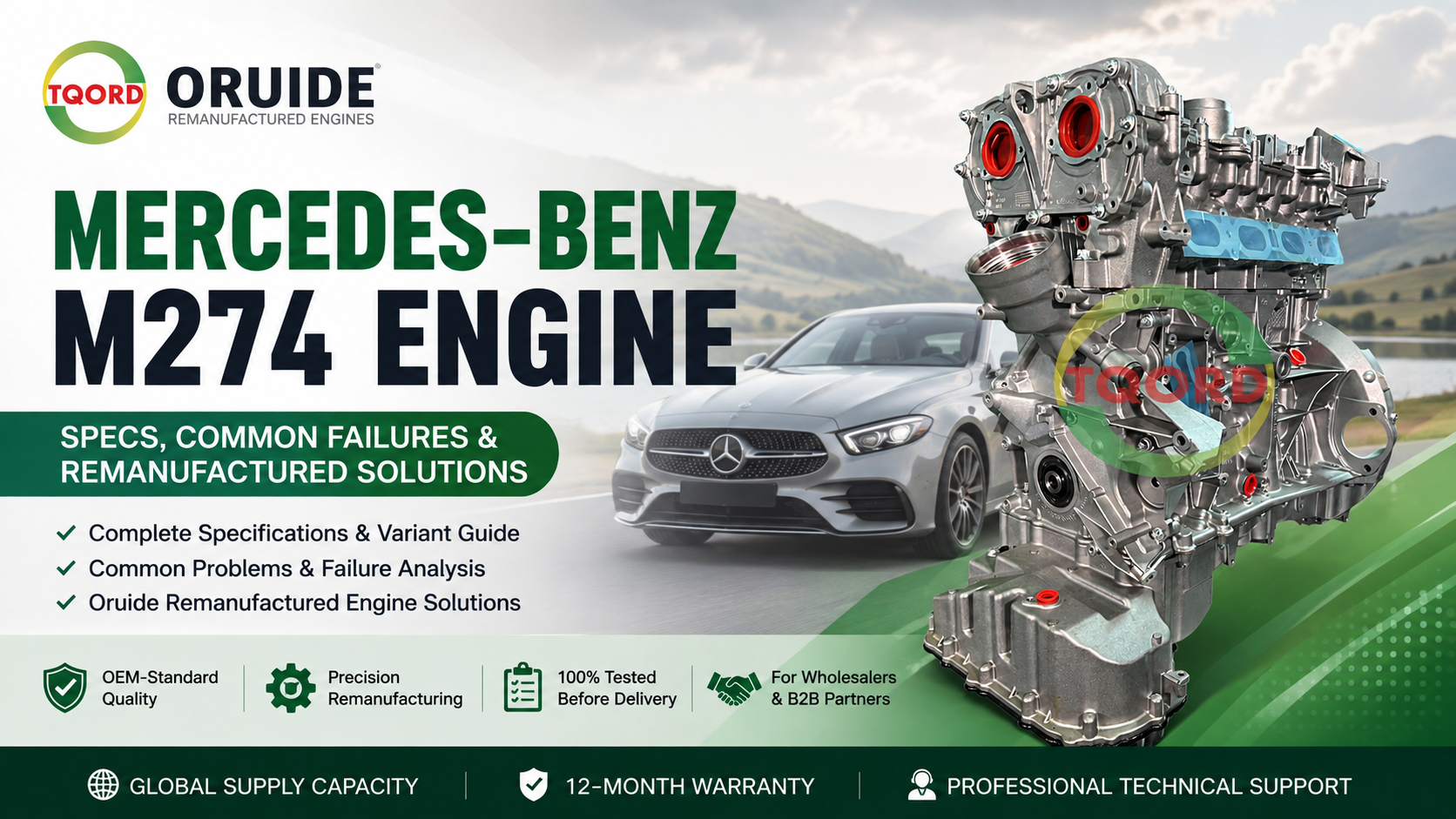
The Mercedes-Benz M274 is a turbocharged inline-four gasoline engine family developed for longitudinally mounted Mercedes-Benz vehicle platforms. Introduced in the early 2010s as a successor to the M271 series, the M274 was produced in both 1.6-liter (M274 DE16 AL) and 2.0-liter (M274 DE20 AL) configurations.
The M274 shares its basic architecture and technologies with the M270 engine family. However, the two should not be treated as identical replacement engines: the M270 was primarily designed for transverse front-wheel-drive applications, while the M274 was developed mainly for longitudinal vehicle platforms.
The engine incorporates direct gasoline injection, turbocharging, dual overhead camshafts, variable camshaft timing and chain-driven valve timing. Depending on the specific version, output varies considerably across different Mercedes-Benz applications.
For automotive wholesalers, regional distributors and professional repair networks, reliable replacement M274 engines remain in steady aftermarket demand. However, because different M274 variants can differ in displacement, output, engine management, accessories and vehicle application, accurate engine identification is particularly important when sourcing remanufactured engines for wholesale or recurring supply.
Mercedes-Benz M274 Engine Technical Specifications
Parameter |
Specification |
Engine Family |
Mercedes-Benz M274 |
Main Versions |
M274 DE16 AL / M274 DE20 AL |
Displacement |
1,595 cc (DE16) / 1,991 cc (DE20) |
Fuel Type |
Gasoline / Petrol |
Configuration |
Inline-4, DOHC, 16-valve |
Aspiration |
Turbocharged |
Bore × Stroke - DE16 |
83.0 mm × 73.7 mm |
Bore × Stroke - DE20 |
83.0 mm × 92.0 mm |
Power Output - DE16 |
Approx. 95-115 kW (129-156 PS), depending on application |
Power Output - DE20 |
Approx. 115-180 kW (156-245 PS), depending on application |
Torque - DE16 |
Approx. 210-250 Nm |
Torque - DE20 |
Approx. 270-370 Nm |
Fuel System |
High-pressure gasoline direct injection |
Injection Pressure |
Up to approximately 200 bar on applicable versions |
Emissions Standard |
Euro 5 / Euro 6 depending on model year and application |
Compression Ratio - DE16 |
Approx. 10.3:1 |
Compression Ratio - DE20 |
Approx. 9.8:1 on common versions |
Cooling System |
Liquid-cooled |
Turbocharger |
Single exhaust-gas turbocharger with charge-air cooling |
Timing System |
Chain-driven DOHC with variable camshaft timing |
Engine Oil |
Mercedes-Benz-approved oil specification according to vehicle/model year |
Engine Weight |
Varies by engine configuration and installed accessories |
12 months / Customized terms available for qualified B2B orders |
The M274 DE16 AL has a displacement of 1,595 cc with an 83.0 mm bore and 73.7 mm stroke, while the more widely encountered M274 DE20 AL uses a 1,991 cc displacement with an 83.0 mm bore and 92.0 mm stroke. Output varies according to vehicle application and calibration.
For B2B replacement-engine procurement, these figures should be treated as family-level reference specifications rather than a substitute for exact engine identification. Engine code, vehicle application, model year and VIN should be verified before final quotation.
Mercedes-Benz M274 Engine Variant Reference
The M274 family includes multiple engine sub-codes. These codes should be retained during replacement-engine identification because engines within the same M274 family are not universally interchangeable. The table below provides a practical family-level reference; the exact vehicle application and configuration should still be confirmed by engine code and VIN.
Engine Code |
Family |
Displacement |
Procurement Note |
M274.910 |
M274 DE16 AL |
1.6L / 1,595 cc |
Verify VIN, model year and market specification. |
M274.920 |
M274 DE20 AL |
2.0L / 1,991 cc |
Multiple output and application configurations exist. |
M274.922 |
M274 DE20 AL |
2.0L / 1,991 cc |
Confirm exact vehicle application and configuration. |
M274.923 |
M274 DE20 AL |
2.0L / 1,991 cc |
Confirm exact vehicle application and configuration. |
M274.930 |
M274 DE20 AL |
2.0L / 1,991 cc |
Confirm exact vehicle application and configuration. |
M274.932 |
M274 DE20 AL |
2.0L / 1,991 cc |
Confirm exact vehicle application and configuration. |
M274.940 |
M274 DE20 AL |
2.0L / 1,991 cc |
Confirm exact vehicle application and configuration. |
Although M274.910, M274.920, M274.922, M274.923, M274.930, M274.932 and M274.940 belong to the same M274 engine family, they should not be treated as universally interchangeable. Differences may exist in displacement, output calibration, turbocharger configuration, sensors, accessories, emissions equipment and vehicle application. For replacement-engine procurement, Oruide recommends confirming the exact engine code and VIN before quotation.
Compatible Models
The M274 was primarily used in longitudinally mounted Mercedes-Benz applications. Depending on model year, market and output version, applications include:
- Mercedes-Benz C-Class (W204 / W205)
- Mercedes-Benz E-Class (W212 / W213)
- Mercedes-Benz GLK-Class (X204)
- Mercedes-Benz GLC (X253 / C253)
- Mercedes-Benz SLK / SLC (R172)
- Selected Mercedes-Benz V-Class / Vito applications
- Infiniti Q50 2.0t
Specific applications vary significantly according to the M274 variant and regional vehicle specification. Different versions of the 2.0L M274 DE20 AL were used across multiple Mercedes-Benz applications at different output levels.
For wholesalers and repair networks, vehicle model alone should therefore not be used to determine compatibility.
The exact engine code and VIN should be verified before ordering, particularly when engines are being sourced in bulk for multiple vehicle applications.
Common Known Issues for Mercedes-Benz M274 Engine
Even with its relatively advanced factory design, aging and high-mileage M274 engines can develop several recurring problems that professional repair businesses and replacement-engine buyers should consider.
1. Timing Chain and Timing-System Wear
Timing-system wear is one of the areas that should be inspected carefully on higher-mileage M274 engines. Chain elongation, tensioner wear and related timing components can contribute to abnormal startup noise or timing deviations. If timing-related symptoms are ignored, incorrect camshaft-to-crankshaft synchronization can potentially lead to more serious engine damage. During remanufacturing, the timing chain, guides, tensioner and associated timing components should therefore be inspected as a complete system rather than replacing only the component showing the most obvious wear.
2. Direct-Injection Carbon Deposits
The M274 uses high-pressure gasoline direct injection. Because fuel is injected directly into the combustion chamber rather than passing over the intake valves, deposits can accumulate in the intake tract and on intake valves over extended operation. Depending on operating conditions and maintenance history, excessive deposits may contribute to rough idle, reduced airflow or performance deterioration. For remanufactured engines, intake-system condition should therefore be inspected and cleaned as required rather than assuming every engine requires the same treatment.
3. Cooling-System Leaks
Aging cooling-system components, seals and connections can develop coolant leakage over time. Any M274 core showing evidence of previous coolant loss or overheating should undergo additional inspection because prolonged overheating can create secondary damage to sealing surfaces, the cylinder head and other critical components.
4. Camshaft Adjustment and Valve-Control Related Faults
The M274 uses variable camshaft timing, and some versions incorporate additional valve-control technologies. Faults involving camshaft adjustment components, actuators, sensors or associated oil-control systems can produce warning codes, abnormal operation or reduced engine performance. Importantly, Camtronic should not be described as a universal feature of every M274 variant. Diagnosis and remanufacturing requirements should be based on the exact engine configuration.
5. Turbocharger and Lubrication-Related Wear
Higher-mileage turbocharged engines can develop wear involving the turbocharger, oil seals, lubrication system or related oil-feed and return components. Turbocharger symptoms should not automatically be treated as an isolated turbo failure. Oil pressure, lubrication condition, crankcase ventilation and the engine's overall condition should also be evaluated to identify the actual root cause.
At Oruide, our engineering team has accumulated practical experience in Mercedes-Benz M274 failure analysis and remanufacturing. Instead of simply replacing visibly damaged components, we evaluate the root cause of engine failures and inspect related systems before determining the appropriate remanufacturing solution.
Where technically appropriate, vulnerable components can be replaced with updated or improved alternatives according to the specific engine configuration.
With experience supplying remanufactured engines to international markets, Oruide supports wholesalers, automotive distributors and professional repair networks requiring recurring or bulk M274 engine supply.
Oruide Remanufacturing Workflow for M274 Engines
Our remanufacturing process follows a controlled workflow designed to provide consistent engine quality for professional aftermarket customers.
1. Complete Teardown & Full Inspection
Every core engine is completely disassembled. Major components are cleaned and inspected using visual, dimensional and appropriate non-destructive inspection methods where required. Components are then classified for reuse, machining, repair or replacement according to their actual condition.
2. Precision Machining
The cylinder block, cylinder head, crankshaft and other critical components are dimensionally inspected. Machining operations such as surface resurfacing, cylinder treatment or crankshaft reconditioning are performed when inspection results indicate that they are required, rather than automatically machining every component. The objective is to restore critical dimensions and sealing surfaces to the required remanufacturing specifications.
3. Component Replacement of Wearing Parts
Critical wear components - including gaskets, seals, bearings, piston rings and timing-system components - are inspected and replaced according to the remanufacturing specification. Known M274 risk areas receive additional inspection, and updated components may be used where technically appropriate and compatible with the specific engine variant.
4. Assembly Under Controlled Workshop Conditions
Engines are assembled using controlled technical procedures and calibrated torque tools. Critical clearances, timing alignment and tightening specifications are verified during assembly to maintain consistency between remanufactured units.
5. Cold-Test Bench Validation
Each completed Oruide remanufactured M274 engine undergoes cold-test bench validation before shipment. Depending on engine configuration, testing can verify parameters such as oil-pressure generation, engine sealing and leakage, crankshaft rotation characteristics, camshaft-to-crankshaft synchronization, and relevant sensor signals and functional parameters. The objective is to identify assembly or functional abnormalities before the engine leaves the factory.
6. Final Quality Audit and Export-Oriented Packaging
After testing, each engine undergoes a final quality inspection before packaging. For international wholesale orders, Oruide uses export-oriented protective packaging designed to reduce corrosion and transportation damage during long-distance logistics.
If you are an automotive distributor, repair-chain operator or engine sourcing specialist, Oruide supports recurring wholesale and bulk procurement of remanufactured M274 engines.
For partners developing their own aftermarket engine brands, you can also explore our B2B private-label engine solutions, while distributors requiring more predictable availability can combine engine procurement with Oruide's inventory and stocking services.
Frequently Asked Questions
Q1: Are different M274 sub-variants directly interchangeable?
No. Even when two M274 engines share the same basic displacement, differences can exist in engine calibration, sensors, turbocharger configuration, accessories, wiring interfaces, emissions equipment and vehicle installation. The exact engine code and VIN should therefore be verified before ordering.
Q2: What is the difference between a used M274 engine and an Oruide remanufactured M274?
A used engine is generally sold largely in its existing condition, meaning its internal wear and previous operating history may not be fully known. An Oruide remanufactured M274 undergoes complete disassembly, inspection, dimensional measurement, component replacement or machining where required, controlled assembly and bench testing. For distributors and repair networks, this process provides a more standardized replacement product than sourcing engines solely according to external appearance or mileage claims.
Q3: Can Oruide handle bulk-volume M274 engine orders for export?
Yes. Oruide supports wholesale and recurring engine procurement for international B2B customers and has experience with export packaging, technical documentation and international logistics requirements. For distributors with regular M274 demand, inventory planning and stocking arrangements can also be discussed according to expected purchasing volume.
Q4: Does Oruide provide warranty support for remanufactured M274 engines?
Yes. Oruide provides standard warranty support for remanufactured engines. Customized warranty terms can also be discussed for qualified B2B customers according to order volume, market requirements and long-term cooperation arrangements.
Q5: How can I confirm which M274 engine variant I need?
The most reliable approach is to provide the engine code and vehicle VIN. Vehicle model, model year and destination market are also useful for preliminary identification, but VIN verification helps confirm the exact factory configuration before production and final quotation.
Ready to source high-quality remanufactured engines from a reliable engine supplier? Fill out our form to get a customized quote within 24 hours. We’ll help you select the right engine model, confirm MOQ, and outline delivery timelines, so you can source with confidence.