 EN
EN
The Toyota 2TR-FE is a proven 2.7L inline-four gasoline engine from Toyota’s TR engine family, widely recognized for its robust construction, stable power delivery and long service life. Introduced in 2004, this naturally aspirated powertrain has been extensively used in Toyota pickup trucks, SUVs, vans and commercial vehicles across global markets.
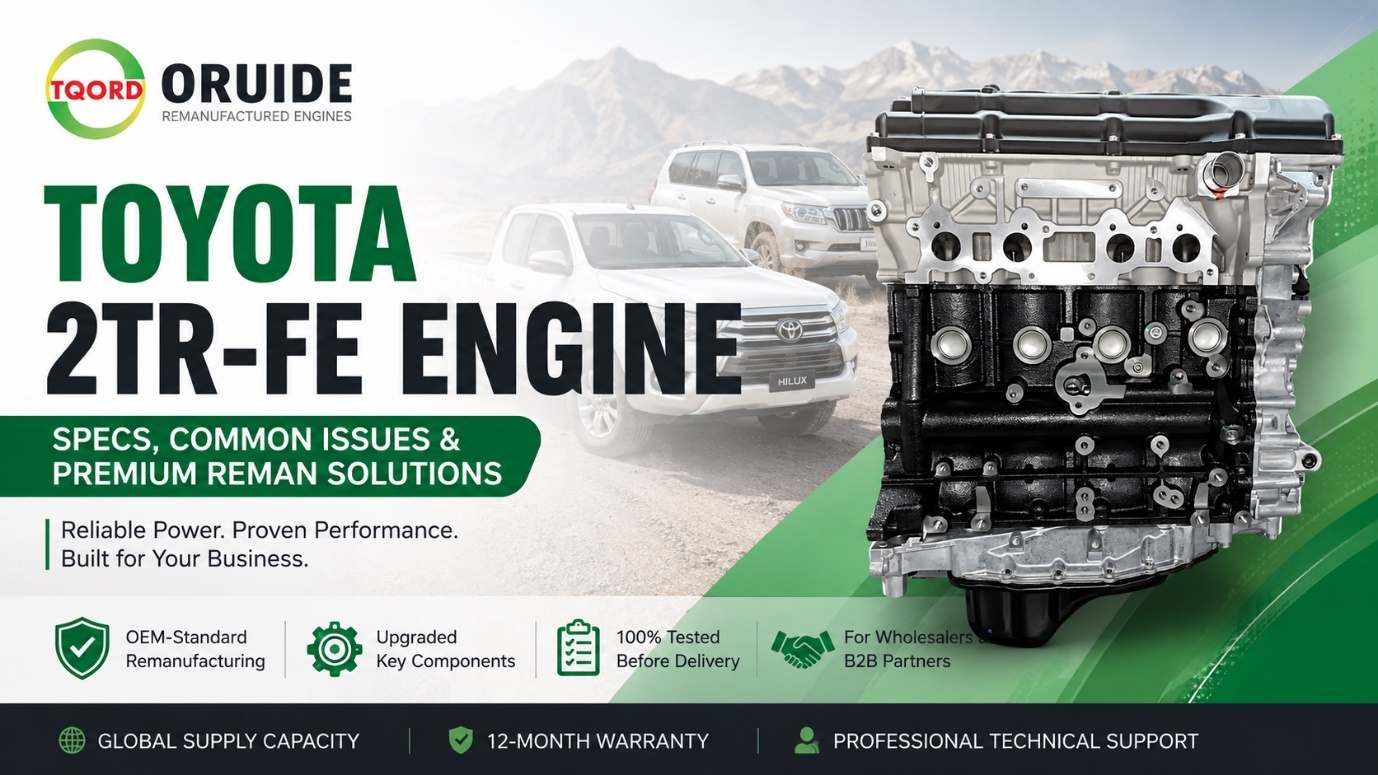
Its combination of a durable cast-iron cylinder block, aluminum DOHC cylinder head and relatively straightforward mechanical architecture has helped the 2TR-FE establish a strong presence in the global replacement-engine market. For engine wholesalers, vehicle parts distributors and professional repair networks serving Toyota commercial vehicles, the 2TR-FE continues to generate consistent aftermarket demand.
Built with a deep-skirt cast-iron cylinder block and aluminum cylinder head, the 2TR-FE uses a timing-chain drive and twin counter-rotating balance shafts to reduce engine vibration. Earlier versions use VVT-i on the intake camshaft, while updated versions introduced from around 2015 adopted Dual VVT-i with variable timing on both intake and exhaust camshafts.
Because the 2TR-FE has been produced for different vehicles and regional markets over many years, specifications such as output, compression ratio, emissions equipment and ancillary components can vary. For B2B replacement-engine procurement, the exact engine specification should therefore be verified by vehicle application, model year, market and VIN before quotation.
Toyota 2TR-FE Engine Technical Specifications
Parameter |
Value |
Displacement |
2,693 cc (2.7L) |
Fuel type |
Gasoline (Petrol) |
Configuration |
Inline 4-cylinder, DOHC, 16-valve |
Aspiration |
Naturally Aspirated |
Bore × stroke |
95.0 mm × 95.0 mm |
Power output |
Approx. 149–164 hp (111–122 kW), depending on model year and market |
Torque |
Approx. 241–246 N·m, depending on model year and market |
Fuel system |
Electronic Multi-Point Fuel Injection |
Emissions standard |
Varies by model year and destination market; verify vehicle-specific emissions configuration before ordering |
Compression Ratio |
Approx. 9.6:1 on earlier versions; around 10.2:1 on later Dual VVT-i versions |
Cooling system |
Pressurized liquid-cooling system |
Turbocharger |
None — Naturally Aspirated |
Timing system |
Timing chain |
Oil type |
Depends on model year, vehicle and operating conditions; follow the applicable Toyota service specification |
Dry weight |
Application-dependent; should not be treated as a universal 2TR-FE specification |
Compatible Models |
Toyota Hilux, Land Cruiser Prado, Fortuner, Tacoma, HiAce, Coaster, Innova, Hilux Surf and selected 4Runner applications |
12 months / Customize |
The original 2TR-FE launched in Toyota commercial-vehicle applications produced approximately 111 kW (151 PS) at 4,800 rpm and 241 N·m at 3,800 rpm. Later Dual VVT-i versions received revised specifications, so buyers should avoid identifying a replacement engine solely by displacement and nominal power.
This distinction is particularly important for wholesalers and repair businesses sourcing engines for multiple markets. A 2TR-FE supplied for one vehicle or region may differ in emissions equipment, sensors, intake and exhaust configuration, accessories or calibration from another engine carrying the same basic 2TR-FE designation.
Common 2TR-FE Weak Points & Failure Analysis
Although the 2TR-FE is generally regarded as a durable engine, high-mileage units can develop several recurring age- and wear-related problems that are important for professional repair businesses and replacement-engine buyers.
One recognized issue on earlier applications is deterioration or leakage around the No. 1 water bypass pipe and associated cooling-system components. Early engine designs used a plastic water bypass pipe. Repeated thermal cycling and long-term aging can contribute to cracking or leakage, resulting in coolant loss and, if not detected promptly, engine overheating.
This issue deserves particular attention during remanufacturing because severe overheating can cause secondary damage to the cylinder head, head gasket and other engine components. Simply repairing the visible coolant leak without inspecting the consequences of previous overheating may therefore leave hidden damage unresolved.
Another documented issue on some earlier 2TR-FE applications is front crankshaft oil-seal leakage. Valve-cover gaskets and other sealing components can also deteriorate as mileage and engine age increase. During professional remanufacturing, sealing surfaces should be inspected rather than simply replacing external gaskets without evaluating the underlying component condition.
High-mileage engines may also develop timing-chain or tensioner wear, abnormal mechanical noise, reduced compression, increased oil consumption or other wear-related symptoms depending on maintenance history and operating conditions.
The 2TR-FE uses balance shafts to reduce vibration, so the balance-shaft system should also be inspected during a complete remanufacturing process when abnormal vibration or internal wear is present. However, balance-shaft bearing failure should not be described as a universal or inherent 2TR-FE factory defect.
Similarly, because the 2TR-FE uses port fuel injection rather than gasoline direct injection, heavy intake-valve carbon accumulation should not be presented as one of its defining common faults in the same way it might be for certain direct-injection engines.
For bulk buyers, these distinctions matter. A professional remanufacturing program should be based on actual failure analysis and dimensional inspection rather than replacing a predetermined list of parts regardless of engine condition.
Oruide has accumulated experience in remanufacturing Toyota 2TR-FE engines for international aftermarket applications. During remanufacturing, known age-related risk areas—including cooling-system components, sealing systems, timing components and internal wear surfaces—are inspected and addressed according to the condition and specification of each engine.
Where the applicable engine configuration permits, vulnerable earlier cooling-system components can be replaced with updated or more durable alternatives. The objective is to address the root causes identified during inspection while maintaining compatibility with the customer’s specific vehicle application.
Oruide Professional 2TR-FE Remanufacturing Process & B2B Advantages
Oruide provides remanufactured Toyota 2TR-FE engines for international wholesalers, vehicle parts distributors, repair networks and other professional aftermarket customers.
Our standardized remanufacturing workflow begins with complete engine disassembly and thorough component cleaning, followed by inspection and dimensional measurement of critical parts such as the cylinder block, cylinder head, crankshaft, connecting rods and cylinder bores.
Machining operations—including cylinder honing and crankshaft reconditioning—are performed when inspection measurements indicate that they are required, rather than automatically machining every component regardless of condition.
Wear components such as piston rings, bearings, gaskets and seals are replaced according to the remanufacturing specification. Timing-chain components, tensioners and guides are inspected and renewed when required to restore correct timing-system operation.
Particular attention is paid to cooling-system integrity and sealing areas on older 2TR-FE cores. Engines with evidence of previous overheating undergo additional inspection to identify potential cylinder-head distortion, sealing-surface damage or other heat-related problems before reassembly.
Different from basic rebuilt engines that may focus primarily on replacing visibly damaged parts, Oruide’s remanufacturing process combines failure analysis, dimensional inspection, component reconditioning, controlled assembly and final testing.
Completed engines undergo bench testing and final verification according to the applicable engine configuration. Test items can include oil-pressure stability, coolant-temperature control, idle stability, leakage inspection and general operating performance.
Rather than claiming that testing can guarantee “zero hidden faults,” the objective of the final inspection is to identify abnormalities before shipment and provide B2B customers with a more consistent and predictable replacement-engine product.
For wholesalers and repair networks managing recurring engine demand, Oruide also supports bulk procurement, inventory planning, export documentation, technical support and customized cooperation programs. Engine specifications can be confirmed before production according to the vehicle application, VIN and destination market, helping reduce compatibility problems and after-sales risk.
Frequently Asked Questions (FAQ)
Q1: What vehicles does the Toyota 2TR-FE engine fit?
The 2TR-FE has been used in numerous Toyota vehicles, including the Hilux, Land Cruiser Prado, Fortuner, Tacoma, HiAce, Coaster, Innova, Hilux Surf and selected 4Runner applications.
However, engine compatibility should not be determined from the vehicle model alone. Model year, regional specification, emissions configuration and VIN should be checked before ordering a replacement engine.
Q2: What are the most common problems with the 2TR-FE engine?
The 2TR-FE is generally considered a durable engine. On older or high-mileage units, issues can include coolant leakage from early water-bypass components, front crankshaft oil-seal leakage, aging gaskets and seals, timing-system wear and other mileage-related internal wear.
Previous overheating should also be carefully investigated because it can cause secondary cylinder-head or head-gasket damage.
Q3: Does Oruide address known weak points when remanufacturing 2TR-FE engines?
Yes. Oruide’s remanufacturing process includes inspection of known age-related risk areas such as cooling-system components, sealing systems, timing components and internal wear surfaces.
Where technically appropriate for the specific engine configuration, vulnerable components can be replaced with updated or more durable alternatives. Every solution is determined according to engine condition and application rather than applying the same modification indiscriminately to every 2TR-FE.
Q4: Does Oruide support bulk wholesale and export of 2TR-FE engines?
Yes. Oruide supplies remanufactured engines for professional B2B customers including engine wholesalers, vehicle parts distributors and repair networks. We support recurring and bulk orders, export documentation, inventory planning, technical support and customized warranty arrangements according to the cooperation requirements.
Q5: What is the service life of an Oruide remanufactured 2TR-FE engine?
Engine service life cannot responsibly be guaranteed as a single mileage figure because it depends on vehicle application, installation quality, maintenance intervals, operating load, cooling-system condition, lubricant selection and driving environment.
Oruide focuses instead on controlled remanufacturing, dimensional inspection, replacement of required wear components, correct assembly and final testing to provide consistent engine quality and help professional buyers reduce avoidable after-sales risk.
Ready to source high-quality remanufactured engines from a reliable engine supplier? Fill out our form to get a customized quote within 24 hours. We’ll help you select the right engine model, confirm MOQ, and outline delivery timelines, so you can source with confidence.