 EN
EN
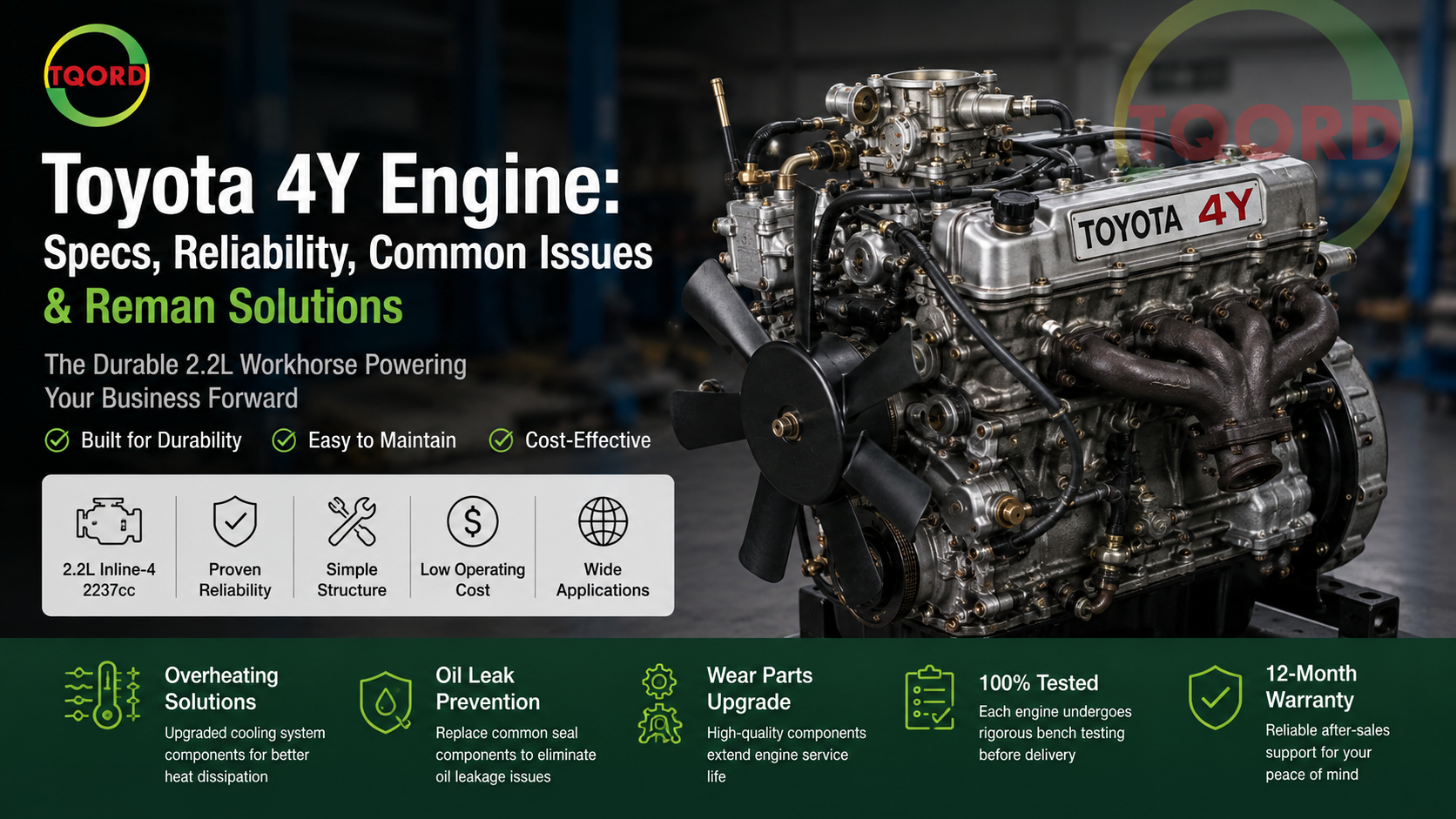
The Toyota 4Y engine is a long-running gasoline powertrain widely used across Toyota commercial vehicles and industrial applications. Developed as part of Toyota’s Y-series engine family, the 4Y combines a simple mechanical architecture with relatively low maintenance requirements, making it a common engine in vans, pickups, light commercial vehicles and industrial equipment.
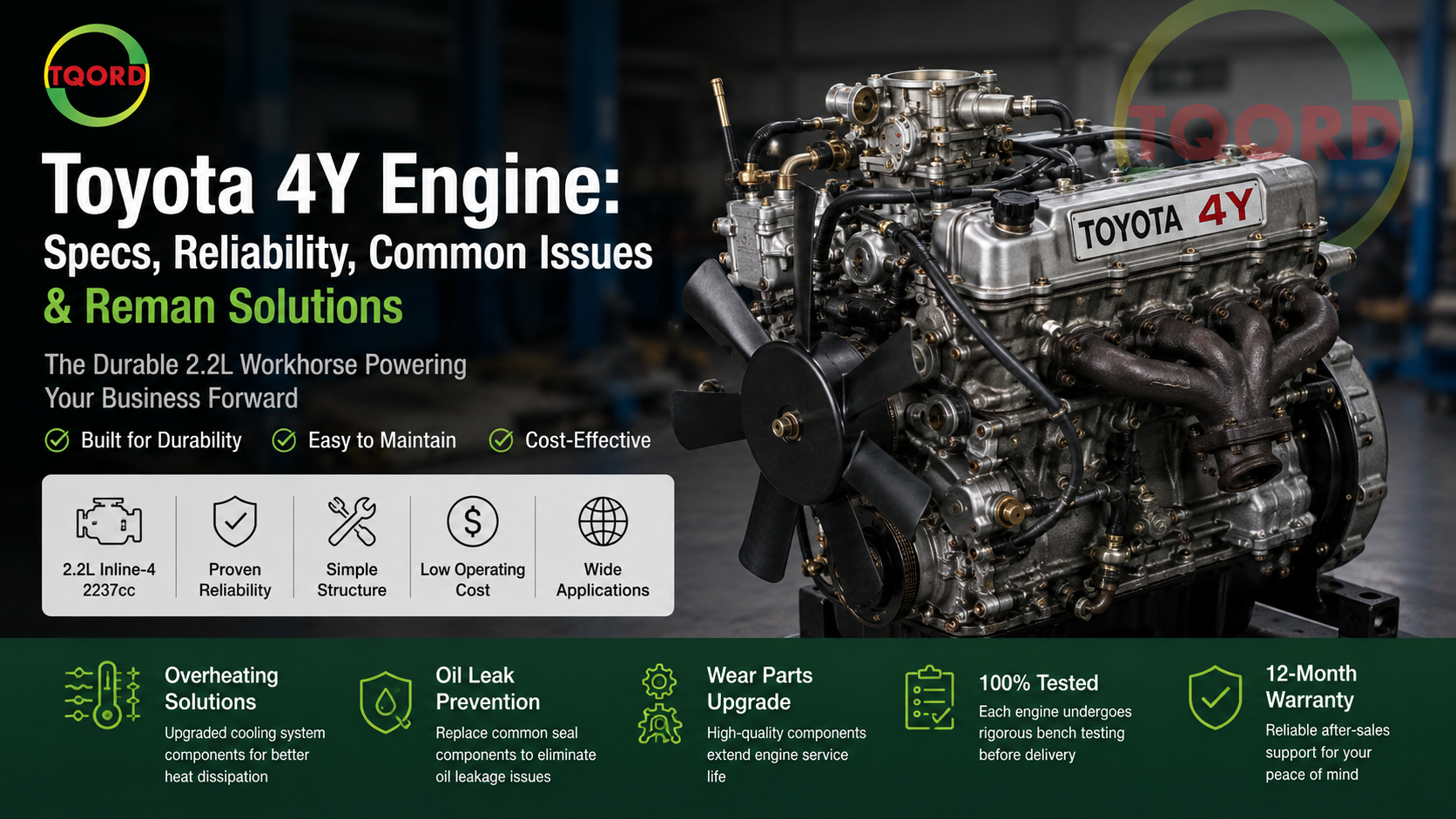
With a displacement of 2,237 cc (commonly referred to as 2.2L or approximately 2.24L), the Toyota 4Y is a naturally aspirated inline-four gasoline engine. It uses an OHV pushrod valve train with eight valves, a cast-iron cylinder block, an aluminum cylinder head and a timing-chain drive. The engine was produced in different configurations, including carbureted versions and electronically fuel-injected variants such as the 4Y-E.
For engine wholesalers, vehicle repair shops, parts distributors and commercial equipment service providers, the Toyota 4Y remains relevant in the aftermarket because many vehicles and industrial applications powered by this engine are still in operation. However, correct engine identification is important because different 4Y configurations should not automatically be considered interchangeable.
Toyota 4Y Engine Specifications
Parameter |
Specification |
Engine Family |
Toyota 4Y |
Configuration |
Inline 4-cylinder |
Valve Train |
OHV pushrod, 8-valve |
Displacement |
2,237 cc (2.2L / approx. 2.24L) |
Bore × Stroke |
91 mm × 86 mm |
Aspiration |
Naturally aspirated |
Fuel Type |
Gasoline; some applications support LPG |
Fuel System |
Carburetor or EFI, depending on version |
Compression Ratio |
Approx. 8.8:1–9.0:1, depending on version |
Timing System |
Timing chain |
Cylinder Block |
Cast iron |
Cylinder Head |
Aluminum |
Typical Power Output |
Approx. 90–110 HP, depending on version and application |
Typical Torque Output |
Approx. 165–190 N·m, depending on version and application |
Compatible Vehicle |
- Toyota HiAce (H50‑H70): 3rd‑generation van & passenger bus, 1985‑1995 - Toyota Hilux (N80‑N110 / YN85, YN106): Pickup truck, 1988‑1997 - Toyota Town‑Ace / Lite‑Ace: Light van & light truck - Toyota Dyna: Light‑duty truck - Toyota 4Runner (select overseas‑market variants) - Toyota Crown YS132: Commercial‑spec Crown for limited markets - Volkswagen Taro: Rebadged pickup manufactured by Toyota |
12 months |
The exact power and torque specifications should always be checked against the specific engine version and application rather than treated as universal values for the entire Toyota 4Y family. Different output ranges are associated with carbureted 4Y and EFI 4Y-E versions.
For B2B engine procurement, the distinction between different 4Y configurations should therefore be confirmed before quotation. Fuel-system configuration, application, vehicle specification and regional requirements can affect engine selection and the components required during remanufacturing.
Toyota 4Y Compatible Vehicles and Applications
The Toyota 4Y has been used in a variety of commercial and utility vehicles, including applications within the Toyota HiAce, Hilux, TownAce/LiteAce and Dyna ranges. Selected overseas-market Toyota 4Runner and Toyota Crown applications have also been associated with the engine, while the Volkswagen Taro represents another application related to Toyota’s pickup platform.
The 4Y engine also has a significant presence in industrial equipment, particularly forklift applications.
However, automotive and industrial 4Y engines should not automatically be considered interchangeable. Differences may exist in fuel systems, accessories, calibration, mounting configurations and operating specifications.
Industrial engines may be configured around continuous low-speed operation, whereas automotive versions are designed around road-driving requirements. For wholesalers and repair businesses, confirming the exact application before placing an order can prevent compatibility problems and unnecessary inventory costs.
Common Toyota 4Y Engine Problems
1. Cooling System Deterioration and Overheating
Overheating is one of the most important problems to check on an aging Toyota 4Y engine. Aging radiators, water pumps, hoses and cooling passages can gradually reduce cooling efficiency. Under sustained heavy-load operation, insufficient cooling may eventually contribute to head-gasket failure or other heat-related engine damage. During remanufacturing, the condition of the cooling-related components and passages should therefore receive particular attention rather than simply replacing the failed head gasket.
2. Oil Leakage
Oil leakage is another common age-related problem. Valve-cover gaskets, oil-pan seals and other sealing components can deteriorate after extended service. Although minor leaks may initially appear to be a relatively small maintenance issue, continued oil loss can increase maintenance requirements and potentially contribute to more serious lubrication problems if ignored.
3. Unstable Idle and Fuel-System Problems
Carbureted Toyota 4Y engines may develop unstable idle, poor fuel delivery or increased fuel consumption as carburetor and related fuel-system components age. For remanufactured engines, it is therefore important to identify whether the required unit is a carbureted 4Y or an EFI 4Y-E configuration before production and quotation.
4. Valve-Train and Piston-Ring Wear
Long-term operation can also result in valve-train noise and piston-ring wear. For a professional repair shop or engine distributor, replacing individual external components may not always provide the most commercially efficient solution when several internal systems have already reached advanced stages of wear. In these situations, a professionally remanufactured long block or complete engine can provide a more standardized and predictable replacement option.
Why Remanufacturing the Toyota 4Y Makes Sense for B2B Buyers
The continued aftermarket demand for the Toyota 4Y creates opportunities for wholesalers, parts distributors and repair networks serving markets where older Toyota commercial vehicles and industrial equipment remain operational.
Compared with sourcing used engines of unknown history, professionally remanufactured engines can provide greater consistency because critical components are inspected, measured, machined or replaced according to defined requirements before assembly.
For B2B customers, this distinction is particularly important. An engine failure does not only create the cost of replacing the engine itself. For a distributor or professional repair business, inconsistent engine quality can also result in additional installation labor, warranty claims, return freight, vehicle downtime, customer complaints and additional after-sales costs.
A standardized remanufacturing process can therefore help businesses control the overall cost and risk associated with replacement-engine procurement.
Oruide Toyota 4Y Remanufacturing Process
Oruide remanufactures Toyota 4Y and 4Y-E engines with particular attention to the age-related failure points commonly found in these engines. The objective is not simply to clean and reassemble a used engine, but to inspect its critical components and restore the engine according to controlled remanufacturing requirements.
Core Engine Inspection
The incoming engine is first inspected to evaluate the overall condition of the core and identify visible damage or potential failure points.
Complete Disassembly and Cleaning
The engine is completely disassembled, and individual components are thoroughly cleaned so that wear, cracks, corrosion and other defects can be properly identified.
Dimensional Inspection
Critical components are measured and inspected against the required technical specifications. Components that fall outside acceptable limits are machined, repaired or replaced as required.
Wear-Part and Sealing Component Replacement
Aging sealing components and vulnerable wear parts are replaced according to the engine condition and required configuration. For Toyota 4Y engines, particular attention is given to sealing areas and cooling-related components because these are frequently associated with problems on aging units.
Cooling-System Inspection
Cooling passages and related components are inspected to identify deterioration that could contribute to future overheating. Rather than claiming that remanufacturing can completely eliminate every possible future overheating problem, Oruide's process specifically addresses common cooling-system deterioration and other age-related failure points identified during inspection.
Controlled Engine Assembly
The engine is reassembled according to controlled assembly procedures, including specified torque requirements for critical fasteners.
Bench Testing and Quality Inspection
After assembly, the completed engine undergoes bench testing and final quality inspection before shipment. For wholesalers and repair networks, this standardized process helps provide more consistent engine quality across recurring and bulk orders.
Toyota 4Y Engine Supply for Wholesalers and Repair Networks
The Toyota 4Y is an older engine platform, but its age does not eliminate its commercial value. In many regions, Toyota commercial vehicles and industrial equipment from previous generations remain operational, creating continued replacement-engine demand.
Oruide provides Toyota 4Y and 4Y-E remanufactured engine solutions primarily for professional automotive businesses with recurring or bulk requirements, including engine wholesalers, vehicle parts distributors, commercial vehicle parts suppliers, multi-location repair networks, fleet maintenance businesses and industrial equipment service companies.
For these customers, stable engine supply is just as important as the quality of an individual engine.
Oruide can support B2B procurement with engine configuration confirmation, technical documentation, export documentation and after-sales support. For bulk orders, customized warranty terms and inventory planning can also be discussed according to the customer's market and purchasing requirements.
This allows professional buyers to establish a more predictable supply channel rather than relying on one-off used-engine purchases.
Frequently Asked Questions About the Toyota 4Y Engine
Is the Toyota 4Y a diesel engine?
No. The Toyota 4Y is a gasoline engine. Different configurations include carbureted and electronic fuel-injection versions, and some applications may support LPG conversion.
What is the displacement of the Toyota 4Y engine?
The Toyota 4Y has a displacement of 2,237 cc, commonly described as a 2.2L engine or approximately 2.24L.
What are the most common Toyota 4Y engine problems?
Common problems on aging engines include cooling-system deterioration and overheating, oil leakage from aging seals, unstable idle on carbureted versions, valve-train noise and piston-ring wear.
Are automotive and industrial Toyota 4Y engines interchangeable?
They should not automatically be considered interchangeable. Fuel-system configuration, calibration, accessories, mounting arrangements and operating specifications may differ between applications. For B2B procurement, the exact application should therefore be confirmed before quotation and production.
Is a remanufactured Toyota 4Y better than a used engine?
They represent different types of replacement products. A used engine is generally supplied largely in its existing condition, while a professionally remanufactured engine undergoes disassembly, inspection, component evaluation, replacement or machining where required, controlled assembly and testing. For wholesalers and repair networks requiring more consistent product quality, a properly remanufactured engine can therefore provide a more predictable replacement solution.
Does Oruide supply Toyota 4Y remanufactured engines for wholesale?
Yes. Oruide supports Toyota 4Y and 4Y-E remanufactured engine supply for wholesalers, vehicle parts distributors, repair networks and other professional B2B customers.
Can Oruide support bulk engine orders?
Yes. For recurring and bulk requirements, Oruide can support engine configuration confirmation, technical documentation, export documentation, inventory planning and after-sales service according to the customer's requirements.
Does Oruide provide customized warranty terms?
Oruide provides standard warranty support and can discuss customized warranty terms for qualified bulk B2B orders according to regional and commercial requirements.
Ready to source high-quality remanufactured engines from a reliable engine supplier? Fill out our form to get a customized quote within 24 hours. We’ll help you select the right engine model, confirm MOQ, and outline delivery timelines, so you can source with confidence.