 EN
EN
For global auto parts wholesalers, independent Audi and Volkswagen repair garages, across Europe, the EA888 series 2.0L turbocharged petrol engine is one of the highest-volume replacement powertrains in the aftermarket. Spanning multiple generations since 2006 EA888 family engines dominate current and future market demand, balancing improved factory engineering with persistent age-related wear issues that create steady demand for optimized remanufactured units.
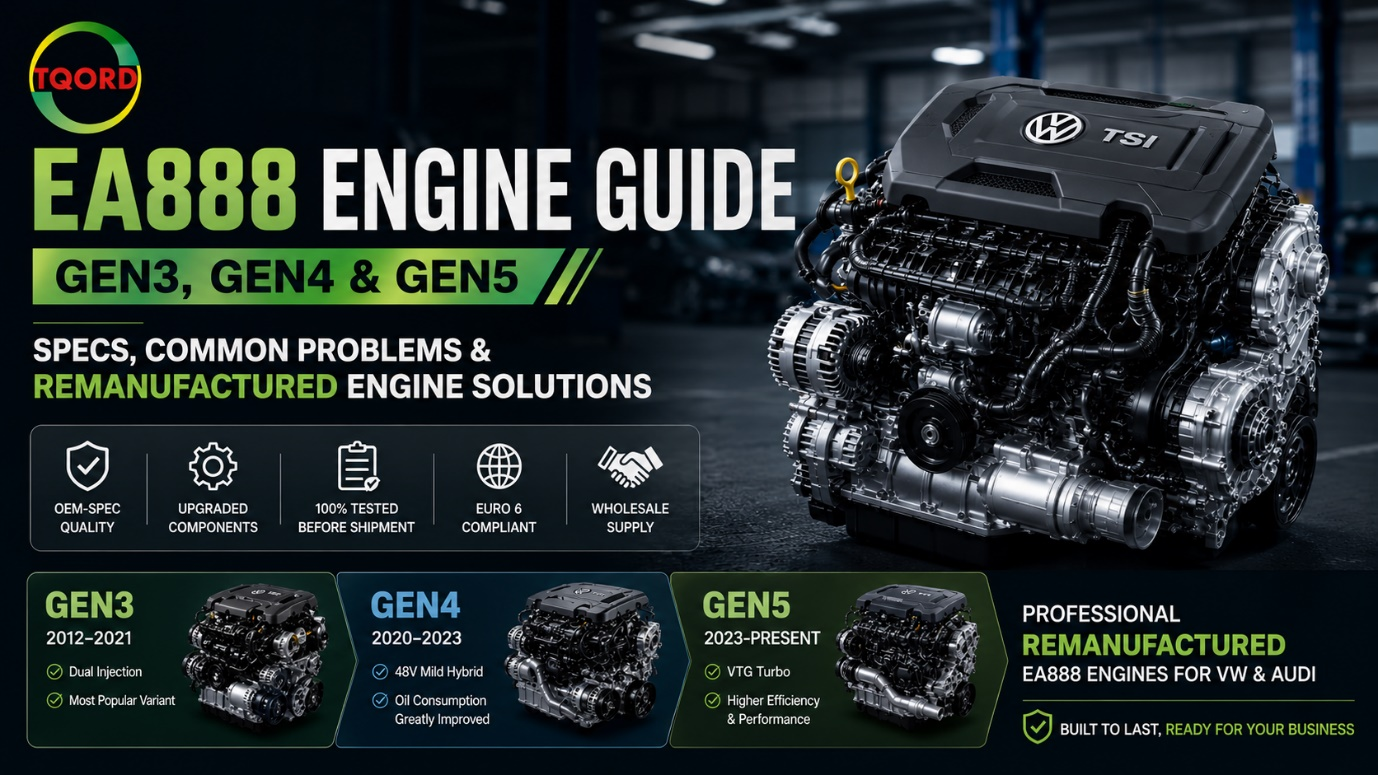
Core Technical Breakdown of EA888 Gen3, Gen4 & Gen5
All EA888 units are inline-four, 16-valve DOHC turbocharged petrol engines built on Volkswagen Group’s modular platform, exclusively gasoline-powered with no diesel variants available. The standard displacement across Gen3 and Gen4 remains 1,984 cc, with a uniform bore and stroke measurement of 82.5 mm × 92.8 mm, fixed compression ratio of 9.6:1, and a dry weight of roughly 148 kg. The latest Gen5 keeps the same displacement base but adopts fully revised internal mechanical and turbo hardware. Each generation carries distinct performance, injection and emission upgrades that alter long-term durability and aftermarket service needs.
EA888 Gen3 (2012–2021 – The Most Popular Wholesale Variant)
Generation |
Displacement |
Engine Code |
Production Years |
Compatible Models |
Market & Reman Notes |
Gen3 (3rd Generation) |
1.8T |
CHHB |
2012–2018 |
VW Magotan B8, VW Passat B8, Audi A4L B9 1.8T |
★ Low-power variant for Chinese market, steady remanufacturing demand |
1.8T |
CYFB |
2013–2020 |
Audi A4 B9, A5, Q5 European Spec |
Exclusive to European market, 180PS low power |
|
1.8T |
CJSB |
2014–2020 |
VW Golf Mk7, Skoda Superb |
Exclusive to European market, 190PS tune |
|
2.0T Low Power |
DKX |
2017–2021 |
VW Magotan B8L, Passat, Tayron, Tiguan L |
★ Core Gen3 model for Chinese market, highest global remanufacturing inquiries |
|
2.0T Low Power |
CJSA |
2012–2018 |
Audi A4 B9, A5, Q5 European Spec |
Exclusive to European market, 190PS tune |
|
2.0T Low Power |
CNCD |
2019–2021 |
VW Teramont, Audi Q3 2.0T |
Exclusive to Chinese market, lightweight calibration |
|
2.0T High Power |
CUH |
2014–2020 |
Porsche Macan 2.0T, Audi S3, Golf R |
★ Global high-end high-power variant, strong premium value for reman units |
|
2.0T High Power |
CJXB |
2012–2018 |
Audi A4 B9 45TFSI, A6L C7 2.0T |
Compatible with China & Europe, factory 252PS tune |
|
2.0T High Power |
CHHA |
2015–2020 |
VW Golf Mk7 R, Audi TT 2.0T |
Global performance variant, factory 310PS tune |
|
2.0T High Power |
CPLA |
2016–2020 |
Audi Q5L 45TFSI, A6L C8 2.0T |
Exclusive to Chinese market, 252PS high power |
The third-generation EA888 revolutionized the platform by adopting dual injection technology, combining low-pressure port fuel injection and 350-bar high-pressure direct injection to drastically reduce intake valve carbon buildup that plagued older models. Fitted with BorgWarner twin-scroll turbochargers and AVS variable valve lift, it splits into two core power tiers for global markets:
- Low-power tune: 140 kW (190 PS) peak power at 4,200–6,000 rpm, maximum torque of 320 Nm from 1,500–4,100 rpm
- High-power tune: 180 kW (245 PS) peak power at 4,500–6,200 rpm, maximum torque of 370 Nm from 1,600–4,300 rpm
Emissions compliance meets Euro 6 standards with gasoline particulate filter (GPF) hardware, and it supports conventional 5W-40 and VW 507 00 5W-30 lubricants. Widely used engine codes for wholesale matching include DKX, CJXB, CUH, CHHB, CNCD, fitted to Audi A4/A5/A6/Q5, VW Golf GTI, Passat, Tiguan, and Porsche Macan 2.0T models sold across Germany, France, the UK and Eastern Europe.
EA888 Gen4 (2020–2023 – Mild-Hybrid Optimized Modern Variant)
The updated Gen4 platform retains the same 1,984 cc displacement and bore/stroke dimensions, with upgraded 350-bar ultra-high-pressure direct injection, electronic turbo wastegate actuators, and compatibility with 48V mild-hybrid systems for late-model European passenger vehicles. Its power output ranges from 150 kW (204 PS) low-power to 221 kW (300 PS) performance spec, with maximum torque extended to 400 Nm on top-tier variants. It fully complies with strict Euro 6d RDE real-driving emissions rules mandatory for European low-emission zones, utilizing revised cooling circuit routing and refined PCV systems to cut factory oil consumption further. Key engine codes for bulk orders include DPL and DKW, matched to Audi A4L B9.5, A6 C8, VW Touareg and Golf 8 GTI platforms.
Generation |
Displacement |
Engine Code |
Production Years |
Compatible Models |
Market & Reman Notes |
Gen4 (4th Generation) |
2.0T Low Power |
DPL |
2020–2023 |
VW Magotan B8.5, Passat, Audi A4L B9.5 |
Exclusive to Chinese market, 48V mild hybrid compatible, emerging reman demand |
2.0T High Power |
DKW |
2020–2023 |
Audi A6L C8, Q5L 45TFSI, VW Touareg |
Global universal, 350bar high-pressure direct injection, oil consumption issue largely resolved |
|
2.0T High Power |
DNNA |
2021–2023 |
Audi S3, Golf Mk8 R |
Performance variant, factory 320PS tune |
EA888 Gen5 Evo5 (2023–Present – New-Generation VTG Turbo Platform)
The fifth-gen EA888 Evo5 retains the 1,984 cc displacement of its predecessors, with identical 82.5 mm bore × 92.8 mm stroke, yet it introduces industry-leading hardware upgrades that redefine efficiency and performance. The signature upgrade is a Porsche-derived VTG variable geometry turbocharger, paired with Miller combustion cycle technology and optimized 350-bar high-pressure fuel injection. Power output spans 195 kW (265 PS) base tune up to 245 kW (333 PS) high-performance spec, delivering a maximum torque of 420 Nm from 1,750 rpm to 5,000 rpm.
Generation |
Displacement |
Engine Code |
Production Years |
Compatible Models |
Market & Reman Notes |
Gen5 (5th Generation) |
2.0T High Power |
EA888 Evo5 |
2023–Present |
Audi A4 B10, VW Golf Mk8.5 R, Porsche Macan EVO |
Latest iteration with VTG turbo, aftermarket reman demand growing year by year |
It fully satisfies Euro 6d RDE and upcoming Euro 7 emission requirements, with integrated 48V mild-hybrid as standard fitment across all variants. Internal friction reduction and reworked thermal management nearly eliminate the oil consumption and overheating faults seen on earlier generations. Current fitted models include the latest Audi A4 B10, Golf 8.5 R, updated Porsche Macan, and new Tiguan MK3. While aftermarket replacement demand is still growing as high-mileage units enter service shops, Oruide has already completed full reverse engineering and remanufacturing process validation for Gen5 engines to support future bulk wholesale orders from European partners.
Brief Note on Gen1 & Gen2 (Older Low-Demand Generations)
While Gen1 and Gen2 EA888 engines (produced 2006–2013) established the model’s market presence, their fundamental design flaws including severe piston ring coking, single-stage oil separation systems and weak timing chain tensioners lead to frequent repeat repairs. These older variants only make up a tiny fraction of current wholesale engine inquiries, so Oruide focuses primary production capacity on the more market-relevant Gen3, Gen4 and Gen5 platforms.
Common Reliability Issues for EA888 Gen3, Gen4 & Gen5
Though factory engineering improvements mitigated the catastrophic oil-burning faults of early EA888 generations, Gen3 and Gen4 engines still develop predictable wear failures after high mileage, creating consistent replacement demand for B2B service partners. Standard local component repairs only address surface symptoms, failing to resolve underlying thermal and lubrication design limitations that trigger recurring breakdowns. Gen5 largely resolves these legacy flaws but presents unique new wear points specific to its VTG turbo system.
1. Turbocharger System Wear (Gen3/Gen4: Actuator Seizure; Gen5: VTG Vane Carbon Buildup)
Prolonged high-temperature operation builds soot deposits on turbo control hardware. Gen3/Gen4 suffer seized electronic boost actuators, while Gen5’s VTG variable vanes are prone to carbon clogging, both causing inconsistent boost pressure, over-boost diagnostic trouble codes and limp-home mode under acceleration. This fault appears frequently in German highway-driven vehicles with long-distance high-load cycles.
2. Cooling System Degradation & Coolant Leaks (Gen3/Gen4 Primary Risk)
Factory plastic water pump impellers and plastic thermostat housings crack under repeated thermal cycling, leading to coolant loss, fluctuating temperature gauges and engine overheating. This is one of the most frequent MOT failure triggers for European VW/Audi fleets. Gen5 upgrades to reinforced composite cooling components to drastically reduce this risk.
3. Timing Chain Tensioner Wear (Gen3/Gen4 Only)
Even revised Gen3/Gen4 timing hardware suffers gradual chain stretch if oil service intervals are extended, creating metallic rattling noise on cold startup and cam/crank timing correlation fault codes. Unaddressed wear risks catastrophic valve-to-piston contact. Gen5’s redesigned hydraulic dual-lock tensioner eliminates this vulnerability.
4. Minor Oil Seepage from Seals & Valve Covers (All Generations)
Age-hardened rubber gaskets on valve covers and timing chain housings allow slow oil leakage, worsened by partial clogging of the crankcase ventilation system. All three modern generations require full seal renewal during remanufacturing.
5. GPF Clogging on Short-Trip Urban Vehicles (Gen3/Gen4/Gen5)
European city-operated vehicles rarely reach full operating temperature, causing soot buildup inside the gasoline particulate filter that restricts exhaust flow and triggers reduced power output.
Oruide’s EA888 Remanufacturing & European Wholesale Export Advantages
Oruide has accumulated more than a decade of hands-on experience remanufacturing Gen3, Gen4 and Gen5 EA888 engines, with dedicated failure analysis teams that dissect hundreds of returned worn units annually to refine targeted upgrade solutions for European market conditions. Unlike generic basic engine rebuilds that only swap broken parts, our process replaces all factory failure-prone components with reinforced revised OEM-spec hardware to eliminate recurring faults at the root—an invaluable benefit for wholesale dealers and repair shops looking to cut costly repeat service work for their customers.
We maintain deep, long-term supply experience serving the European aftermarket, one of ourlong-term European customer is based in German. The upgraded components integrated into our remanufactured EA888 engines drastically reduced the client’s after-sales failure rate, cementing a permanent wholesale cooperation contract that now covers their repair locations across Germany, Austria and Switzerland. We have also finalized full process validation for Gen5 Evo5 engines, ready to support our European partners as demand for the latest generation grows year over year.
Our cross-border export workflow is fully optimized for European logistics rules: we provide complete customs documentation, emission test reports and detailed component upgrade manifests for every bulk shipment, removing compliance
FAQ for Wholesale & B2B European Customers
Q1: Can Oruide’s remanufactured EA888 Gen3/Gen4 engines eliminate recurring turbo and cooling faults for German repair shops? Do you support Gen5 orders?
A: Standard local repair only replaces single failed components without upgrading the original weak factory hardware. Our remanufacturing workflow integrates reinforced revised cooling and turbo control parts for Gen3 and Gen4, permanently resolving the root causes of these common faults and drastically lowering vehicle return rates for your workshop clients. We have fully validated Gen5 remanufacturing processes and can accept pre-orders for bulk Gen5 engine supply as market demand rises.
Q2: Does Oruide support large bulk sale orders for European EA888 inventory stocking across Gen3, Gen4 and Gen5?
A: Absolutely. We maintain steady stock of high-demand Gen3 DKX and Gen4 DKW engine variants, with flexible lead times for recurring wholesale shipments to Germany and other EU markets. We also accept planned bulk pre-orders for the newer Gen5 Evo5 platform. We provide complete export certification, technical data sheets and dedicated after-sales technical support for all bulk partners.
Q3: Will remanufactured EA888 units match all regional VW/Audi platform variants sold in Europe for every generation?
A: Our engineering team adjusts intake piping, ECU compatibility and emission hardware to match each specific engine code ordered across Gen3, Gen4 and Gen5, eliminating fitment or software adaptation issues upon installation for European-spec vehicles.
Q4: Why should buyers provide the VIN before ordering an EA888 engine?
A: Although many Volkswagen and Audi vehicles use the EA888 engine family, not all EA888 engines are interchangeable. Differences in engine generation (Gen3, Gen4, or Gen5), engine code, emission standard (Euro 5, Euro 6, or Euro 6d), turbocharger specification, ECU calibration, intake and exhaust layouts, sensors, and accessory mounting points can vary significantly between vehicles.
Providing the Vehicle Identification Number (VIN) allows Oruide’s engineering team to accurately identify the original engine specification and verify compatibility before production begins. This helps prevent installation issues, incorrect quotations, and unnecessary delays caused by ordering the wrong engine configuration. It also ensures that the remanufactured engine meets the customer’s regional emission requirements and vehicle-specific technical specifications.
Ready to source high-quality remanufactured engines from a reliable engine supplier? Fill out our form to get a customized quote within 24 hours. We’ll help you select the right engine model, confirm MOQ, and outline delivery timelines, so you can source with confidence.