
 EN
EN


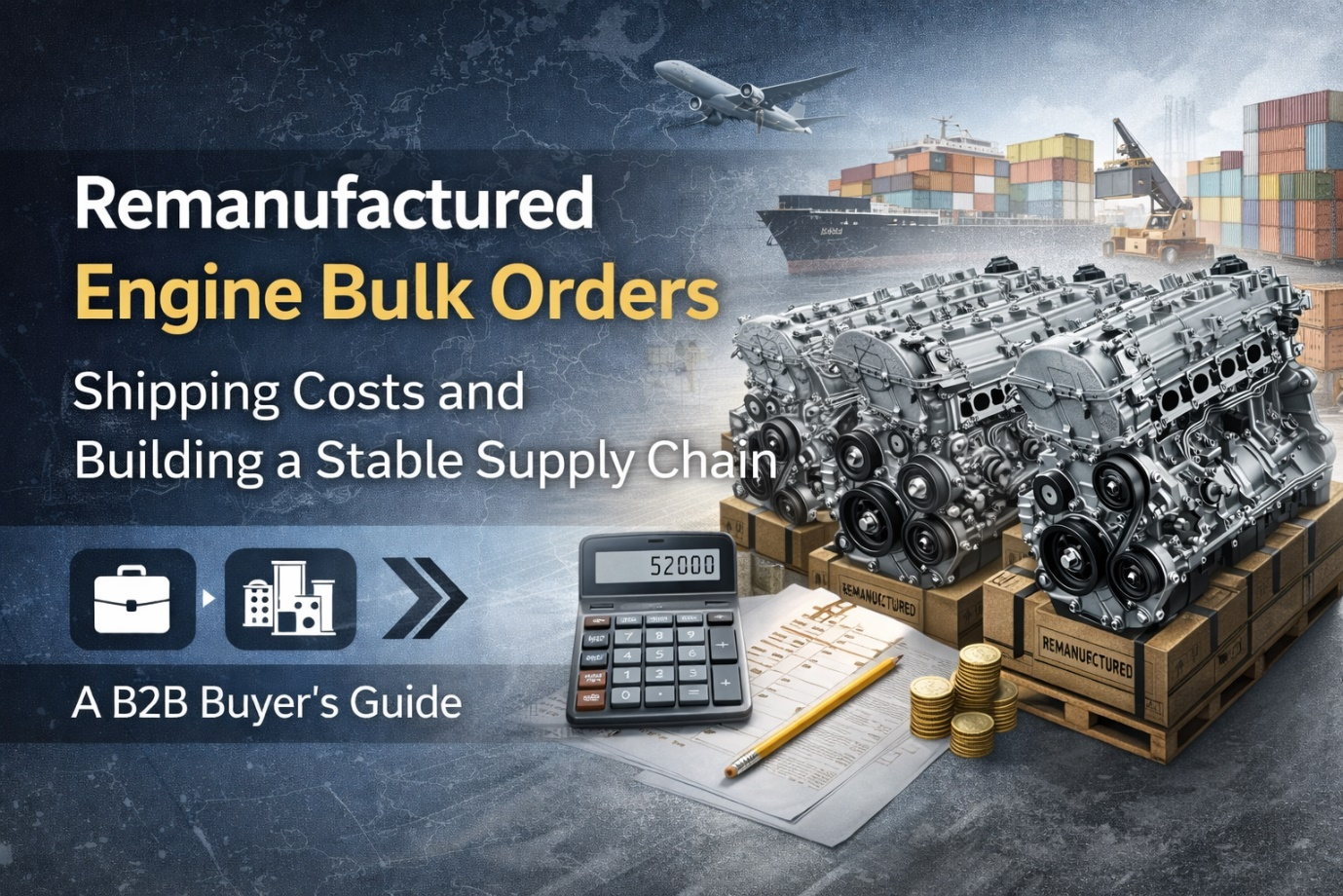
For professional buyers, the key question is not “what is MOQ,” but rather:
How do order quantity, shipping, and supplier collaboration impact total cost and supply stability?
In the remanufactured engine industry, procurement decisions are driven by logistics efficiency, supplier reliability, and long-term cooperation—not by single-unit transactions.
This article focuses on the practical considerations that matter most for B2B buyers.
Shipping Efficiency: The Real Cost Driver
One of the most underestimated factors in engine sourcing is shipping.
Based on industry experience, the cost difference between shipping one engine and shipping in bulk is significant:
▪️ Shipping 1 engine → high cost per unit
▪️ Shipping 50 engines → total cost increases only 7–10 times, not 50 times
This means:
The cost per engine drops dramatically when ordering in volume.
Why This Happens
Shipping remanufactured engines involves:
▪️ Heavy-duty packaging
▪️ Container space utilization
▪️ Fixed logistics handling costs
When shipping a single unit, these fixed costs are not distributed.
In contrast, bulk shipments optimize:
▪️ Container loading efficiency
▪️ Freight cost allocation
▪️ Handling processes
Practical Implication for Buyers
For distributors and workshops:
Ordering in small quantities may seem flexible, but it leads to:
▪️ Higher per-unit cost
▪️ Lower margin
▪️ Less competitive pricing in the market
Bulk procurement is not just a supplier requirement; it is a cost optimization strategy.
Packaging: More Than Just Protection
In international engine trade, packaging is not a secondary detail—it is part of the product quality.
Professional suppliers typically use:
▪️ Reinforced wooden crates
▪️ Moisture and corrosion protection
▪️ Secure fixation to prevent movement
For European customers, packaging must also meet expectations for:
▪️ Transport safety
▪️ Compliance with handling standards
▪️ Long-distance durability
Risks of Inadequate Packaging
Poor packaging can result in:
▪️ Damage during transport
▪️ Oil leakage
▪️ Component misalignment
These issues are especially critical in international shipments where replacement or return is costly and time-consuming.
Beyond Transactions: The Role of Supplier Collaboration
In B2B procurement, the relationship with the supplier is often more important than the initial price.
Professional buyers typically look for:
▪️ Stable supply capability
▪️ Technical communication
▪️ Process transparency
▪️ Long-term cooperation
Supplier Audit and Pre-Order Alignment
Before placing bulk orders, many European buyers require:
▪️ Technical specification alignment
▪️ Quality control documentation
▪️ Process verification
▪️ Supplier audits
This is not a barrier, it is a necessary step to ensure long-term reliability.
Why This Matters
A supplier that can support this process demonstrates:
▪️ Process maturity
▪️ Engineering capability
▪️ Commitment to quality
This significantly reduces risk for buyers.
Case Perspective: Working with European B2B Customers
In practice, cooperation with European customers often follows a structured process.
Based on our experience working with clients in Germany and France, B2B buyers typically focus on:
▪️ Consistency across batches
▪️ Documentation and traceability
▪️ Ability to meet technical requirements
Before supply begins, the process usually includes:
▪️ Defining technical specifications
▪️ Aligning quality control standards
▪️ Completing supplier evaluation procedures
Engineering-Driven Remanufacturing
For example, in our own operations, remanufacturing is not a standardized one-size-fits-all process.
Instead, it is tailored based on:
▪️ Customer technical specifications
▪️ Application requirements
▪️ Quality control documentation
This includes:
▪️ Customized remanufacturing solutions
▪️ Process design aligned with customer standards
▪️ Strict adherence to defined QC procedures
Compliance with European Standards
Although based in China, it is fully possible for a supplier to meet European expectations when:
▪️ Processes are standardized
▪️ Quality systems are implemented
▪️ Documentation is complete
In our case, engines supplied to European customers are designed to meet EU-level requirements and have been validated through real market applications.
Cost vs Stability: The Real Trade-Off
When evaluating suppliers, buyers often compare:
▪️ Unit price
▪️ Lead time
▪️ Minimum quantity
However, the more important comparison is short-term savings vs long-term supply stability
Low-Volume Strategy
▪️ Higher cost per unit
▪️ Less supplier commitment
▪️ Limited customization
B2B Supply Strategy
▪️ Lower cost per unit
▪️ Stable production planning
▪️ Better technical support
▪️ Long-term partnership
Recommended Approach for Professional Buyers
For distributors, wholesalers, and workshop networks, the most effective approach is:
Build a structured relationship with a remanufactured engines for sale supplier
This allows:
▪️ Optimized logistics
▪️ Stable supply
▪️ Predictable quality
Conclusion
In the remanufactured engine industry, procurement decisions are not about single units—they are about systems.
Shipping efficiency, packaging quality, and supplier collaboration all play a critical role in determining total cost and long-term success.
For B2B buyers, the key is not finding the lowest price, but building a supply chain that is:
▪️ Reliable
▪️ Scalable
▪️ Aligned with technical requirements
Ready to source high-quality remanufactured engines from a reliable engine supplier? Fill out our form to get a customized quote within 24 hours. We’ll help you select the right engine model, confirm MOQ, and outline delivery timelines, so you can source with confidence.