
 EN
EN


In the remanufactured engine industry, price is visible, but testing quality determines reliability.
For fleets, logistics companies, construction contractors, and heavy equipment operators, one engine failure can mean:
⭕️unexpected downtime
⭕️ emergency repair costs
⭕️ warranty disputes
⭕️ lost revenue
That is why professional remanufactured engine testing and quality control matter more than unit price.
Unlike simple rebuilt engines, true industrial remanufactured engines must pass engineering-grade inspections, leak tests, pressure tests, and dynamometer performance testing before shipment.
If you are sourcing engines for commercial use, understanding these tests is critical to reducing operational risk.
This guide explains exactly how remanufactured engines are tested, what standards to expect, and how to identify a reliable manufacturer.
Why Remanufactured Engine Testing Matters More Than Price
Many buyers compare suppliers only by cost per unit. This is a mistake.
1. Field failure destroys margins
One failed engine often costs 3–5× more than the initial price difference due to:
⭕️ towing
⭕️ emergency labor
⭕️ equipment downtime
⭕️ replacement rentals
2. Warranty risk increases
Small workshops frequently:
⭕️ offer limited warranties
⭕️ reject claims
⭕️ lack documented testing
Professional remanufacturers provide documented QC and stable warranty coverage.
3. Downtime kills operations
Commercial equipment depends on uptime. A breakdown directly impacts:
⭕️ delivery schedules
⭕️ project deadlines
⭕️ customer trust
Bottom line:
Total Cost of Ownership (TCO) is driven by testing quality, not purchase price.
What Tests Should a Professional Remanufactured Engine Pass?
When evaluating a remanufactured engine supplier, confirm that every unit undergoes the following inspections.
Dimensional Inspection (OEM Tolerance Control)
Precision tools and CMM machines verify:
⭕️ bore sizes
⭕️ crankshaft journals
⭕️ rod alignment
⭕️ head flatness
Parts outside OEM tolerances are re-machined or replaced. This prevents premature wear and vibration.
Crack Detection (Structural Integrity Testing)
Microscopic cracks can cause catastrophic failure.
Industrial facilities use:
⭕️ Magnetic Particle Inspection (MPI)
⭕️ Dye Penetrant Testing
These methods detect hidden defects in:
⭕️ blocks
⭕️ heads
⭕️ crankshafts
⭕️ rods
Any cracked component is rejected immediately.
Pressure Testing (Sealing Verification)
Air or water pressure is applied to:
⭕️ coolant passages
⭕️ oil galleries
⭕️ combustion chambers
This ensures:
⭕️ no coolant leaks
⭕️ no oil mixing
⭕️ no internal sealing failures
A common weak point in low-quality rebuilt engines.
Leak Testing (Fuel & Fluid Safety)
Leak tests verify:
⭕️ fuel systems
⭕️ intake systems
⭕️ exhaust paths
Even small leaks reduce efficiency and increase operating costs. For fleets, fuel loss alone can significantly impact profitability.
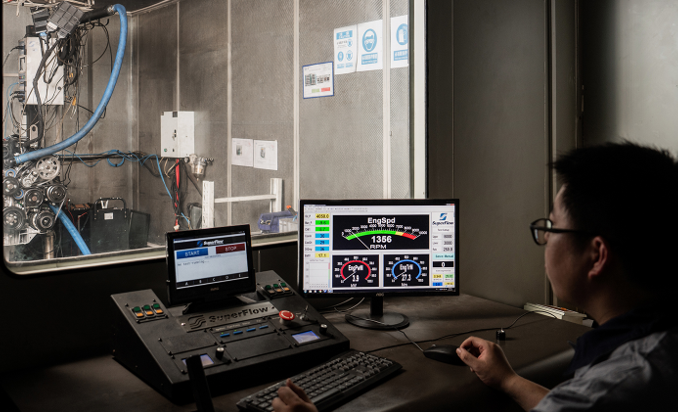
Dynamometer Testing (Full Performance Validation)
The dyno test is the most critical step in remanufactured engine quality control.
Each engine runs under real load conditions while measuring:
⭕️ horsepower
⭕️ torque
⭕️ fuel consumption
⭕️ temperature
⭕️ emissions
⭕️ stability
If performance does not meet OEM-equivalent standards, the engine is reworked.
No shipment without passing this test.
Small Workshop vs Industrial Remanufacturer: Key Differences
Low-Grade Repair Shops
⭕️ visual checks only
⭕️ no dyno testing
⭕️ inconsistent processes
⭕️ reused worn parts
⭕️ unstable quality
Industrial Remanufacturers
⭕️ full documented QC procedures
⭕️ 100% testing on every engine
⭕️ standardized production lines
⭕️ new wear components
⭕️ traceability records
⭕️ reliable warranties
For commercial buyers, this difference directly impacts lifespan and failure rate.
Step-by-Step Remanufactured Engine Testing Workflow
Professional plants integrate testing throughout the process:
Step 1 — Core inspection
Crack detection and pressure testing determine if the core is reusable.
Step 2 — Machining verification
All machined parts are re-measured to OEM specifications.
Step 3 — Assembly quality checks
Torque, clearance, and leak inspections at each station.
Step 4 — End-of-line testing
Every engine completes:
⭕️ cold functional test
⭕️ pressure/leak test
⭕️ dyno performance test
⭕️ final inspection
Only fully compliant units ship. This systematic workflow ensures consistent, repeatable quality.
How to Choose a Verified Remanufactured Engine Supplier
Testing transparency should be mandatory.
Ask suppliers:
⭕️ Do you dyno test every engine?
⭕️ Can you provide QC documentation?
⭕️ Do you follow OEM specifications?
⭕️ Is there traceability for each unit?
If the answer is unclear, risk is high.
For a full evaluation framework, read our Supplier Evaluation Checklist for Remanufactured Engines.
Looking for OEM-Equivalent Remanufactured Engines?
At Oruide, every remanufactured engine follows:
⭕️ standardized production workflow
⭕️ full dimensional inspection
⭕️ pressure & leak testing
⭕️ 100% dynamometer testing
⭕️ documented quality records
We focus on uptime, reliability, and predictable performance for fleets and industrial buyers.
Explore our remanufactured engine solutions to view available models or request a quote for your business.