
 EN


For independent workshops, automotive parts distributors, engine importers and rebuild specialists, Toyota’s 2ZR family is a widely used 1.8L inline-four petrol engine family introduced in the late 2000s. Two key production variants are the naturally aspirated 2ZR-FAE, which uses Valvematic variable valve lift with Dual VVT-i, and the 2ZR-FE, which uses Dual VVT-i. Some markets also offered supercharger conversions based on the 2ZR-FE, including TRD-related applications; these should not automatically be treated as a separate factory engine specification. Applications vary by market, model year and chassis. For B2B buyers, accurate engine-code and VIN verification is essential before sourcing a replacement. Oruide supports aftermarket partners with remanufactured-engine supply and export coordination.
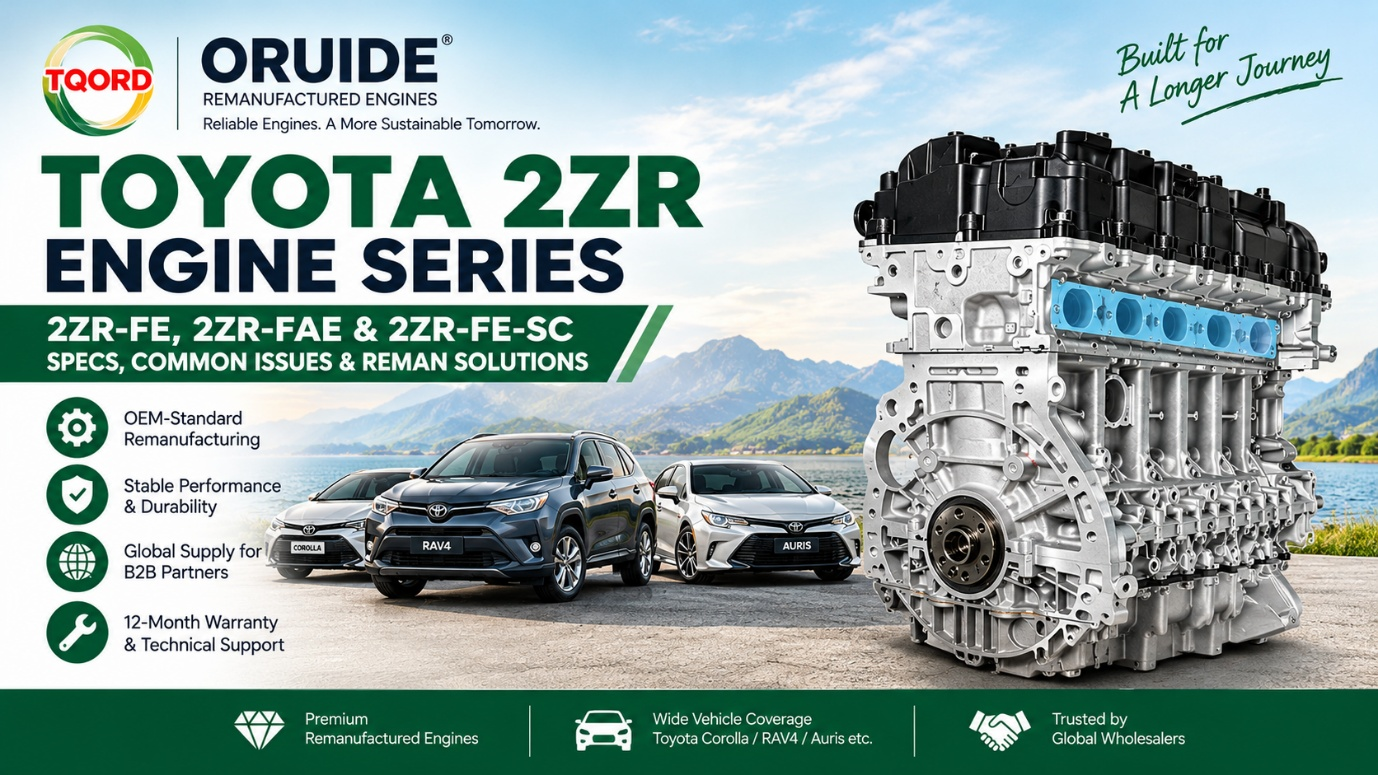
The 2ZR family has a displacement of approximately 1,798 cc and generally uses an aluminium-alloy cylinder block, DOHC 16-valve layout and timing-chain drive. However, specifications such as compression ratio, output, fuel-system configuration, emissions equipment and vehicle fitment vary by engine code and application. The 2ZR-FAE’s Valvematic system distinguishes it from the 2ZR-FE. Supercharger kits and market-specific conversions may also require different ancillary parts and calibration. Do not order by “2ZR” alone; confirm the complete engine code, vehicle VIN, production year and market specification.
Toyota 2ZR Series: Variant Overview
The 2ZR-FE and 2ZR-FAE are naturally aspirated 1.8L petrol engines. Supercharged vehicles are application-specific conversions or market-specific packages, so their power figures and hardware should be verified against the exact vehicle and kit documentation rather than generalized across all 2ZR engines.
Parameter |
2ZR-FAE (application-dependent) |
2ZR-FE (application-dependent) |
Supercharged 2ZR-FE application |
Valve system |
DOHC, 16 valves; Valvematic + Dual VVT-i |
DOHC, 16 valves; Dual VVT-i |
Generally based on 2ZR-FE; confirm kit specification |
Induction / fuel system |
Naturally aspirated; fuel-system details vary by market |
Naturally aspirated; typically port fuel injection |
Supercharger and intercooling arrangement depends on the kit |
Power / torque |
Varies by model, year and market; verify vehicle specification |
Varies by model, year and market; verify vehicle specification |
Do not use a universal figure; verify the exact kit and calibration |
Compression ratio |
Application-dependent; verify engine specification |
Application-dependent; verify engine specification |
May differ from the base engine depending on kit/build |
Emission standard |
Market- and year-specific |
Market- and year-specific |
Depends on donor vehicle, conversion and local certification |
Compatible models |
Selected Toyota / Scion / other market-specific applications; confirm by VIN |
Selected Corolla, Auris and other market-specific applications; confirm by VIN |
Only vehicles and kits documented for the specific conversion |
Core notes |
Valvematic system makes exact variant identification important |
Common naturally aspirated 1.8L variant |
Not a universal factory variant; hardware may not interchange with NA versions |
Subject to agreed terms and confirmation of conversion scope |
|||
Common Failure Points by Variant
2ZR-FAE
- Valvematic actuator or control-system faults: may cause warning lights, reduced power, rough running or related diagnostic trouble codes; confirm with fault-code and system testing.
- VVT-i or Valvematic control issues: inspect oil condition, electrical connections, sensors and actuator operation before replacing components.
- Oil seepage from aged gaskets and water-pump leakage or bearing wear may occur with age and mileage; inspect the specific unit rather than assuming these faults are universal.
2ZR-FE
- Oil consumption has been reported in some applications, including certain 2009 Corolla and Matrix vehicles covered by Toyota service information. Do not apply a blanket production-year range or a fixed consumption rate to every 2ZR-FE; confirm the vehicle, market and service history before diagnosis.
- VVT-i control faults or timing-chain-area rattling can occur; check oil level and condition, fault codes, chain tensioner and related components before determining the root cause.
- Water-pump leaks and cooling-system faults may develop over time. Water-pump location and service procedure depend on the specific application.
- Ageing ignition coils, spark plugs or wiring can cause misfires; diagnose the ignition and fuel systems before attributing a misfire to internal engine damage.
Supercharged 2ZR-FE applications
- For vehicles fitted with an aftermarket or TRD-related supercharger, inspect the specific supercharger drive, coupler, bearings, belt and boost system for noise or loss of boost. Component design varies by kit; do not assume all 2ZR-FE engines use the same supercharger hardware.
- VVT-i-related faults can still occur in the base engine; poor maintenance or contaminated oil may contribute, but diagnosis should be based on inspection and fault codes.
- Check coolant hoses, pump, thermostat housing and any kit-specific intercooler circuit where fitted. Cooling-system layout varies by vehicle and supercharger kit.
Oruide’s remanufacturing approach focuses on inspection and root-cause assessment rather than replacing parts based only on a model-wide fault list. During core evaluation, relevant areas may include cylinder wear, piston and ring condition, valve-train controls, timing components, oil leaks and cooling-system interfaces. The work scope depends on measured condition, applicable specifications and the agreed remanufacturing standard. For engine importers, distributors and independent workshop networks, clear engine-code identification, documented inspection and fitment verification help reduce avoidable returns.
Oruide’s remanufacturing workflow begins with disassembly, cleaning and inspection of reusable components. Critical measurements may include cylinder-bore condition, crankshaft journals, cylinder-head and deck flatness, valve-train condition and timing-component wear. Machining or component replacement is performed only where the measured condition and applicable repair limits support it; components outside service limits are rejected. For 2ZR-FE units with a documented oil-consumption history, the piston and ring condition should be assessed and any repair should follow the applicable Toyota service information and parts specification. For 2ZR-FAE units, inspect the Valvematic assembly and related controls as required by condition. Supercharger-related components must be assessed separately for the exact conversion or kit, where applicable. Assembly uses the relevant engine-specific procedures and specifications. Finished engines undergo the tests included in Oruide’s agreed quality-control process; confirm the exact test scope and report with the supplier before ordering. Export packaging is selected to protect engines during international transport.
When sourcing a remanufactured Toyota 2ZR engine through Oruide, specify the complete engine code, donor vehicle details, VIN where available, destination market and any emissions or ancillary requirements. Our team can assist with compatibility checks before shipment. For supercharged applications, provide the supercharger-kit or vehicle details as well, because these parts and calibrations are not necessarily interchangeable with standard naturally aspirated configurations.
Q&A
Q1: Can I replace a 2ZR-FE with a 2ZR-FAE?
A1: Do not assume it is a direct replacement. The Valvematic system, wiring, ECU calibration, intake and ancillary components may differ. Confirm the vehicle VIN, original engine code, market specification and parts compatibility before proceeding; an engine-code match is the safest starting point.
Q2: What oil specification should be used after remanufacture?
A2: There is no single oil grade that applies to every 2ZR application worldwide. Follow the owner’s manual or repair information for the exact vehicle, model year and market, including the required viscosity and specification. Use the correct oil level and service interval for the application.
Q3: Is the Toyota 2ZR an interference engine?
A3: Valve-to-piston clearance and damage risk depend on the specific engine design and condition. Do not rely on a blanket statement for every 2ZR variant; use the applicable Toyota repair information when assessing timing-chain failure or possible valve contact. Timing components should be inspected against the relevant service limits during remanufacturing.
Q4: Can Oruide supply supercharged 2ZR-FE engines in bulk?
A4: Availability depends on the exact engine, vehicle application and supercharger conversion or kit. Share the engine code, VIN and kit details so compatibility and supply requirements can be reviewed before an order is placed.
Q5: What warranty support is available for Oruide remanufactured 2ZR engines?
A5: Warranty coverage and documentation depend on the agreed order terms and application. Confirm the warranty period, exclusions, claim process and test documentation with Oruide before purchase, particularly for engines used with aftermarket performance modifications.
Ready to source high-quality remanufactured engines from a reliable engine supplier? Fill out our form to get a customized quote within 24 hours. We’ll help you select the right engine model, confirm MOQ, and outline delivery timelines, so you can source with confidence.
Warranty: 12 months / Customized terms available for qualified B2B orders