
 EN
EN



Why Reman Engines Are the Smart Choice for Aging Audi A4 Models
Common Failure Patterns in 2002–2008 Audi A4 1.8T and 2.0T Engines
The 2002–2008 Audi A4’s 1.8T and 2.0T engines are prone to predictable, high-impact failures—especially beyond 120,000 miles. Timing chain tensioner wear is the most frequent root cause of catastrophic timing failure, often preceded by rattling at startup or inconsistent oil pressure. Oil sludge buildup—exacerbated by extended oil change intervals and short-trip driving—clogs narrow passages in the VVT system and oil galleries, starving camshafts and turbochargers of lubrication. Worn piston rings and valve stem seals lead to chronic oil consumption (often 1 quart per 1,000 miles), while aging turbos suffer from coked-up bearings and compressor wheel imbalance. These interrelated issues compound over time: sludge accelerates ring wear, which increases blow-by and further contaminates oil—creating a downward spiral. Early detection helps, but once critical tolerances are lost, replacement—not repair—is the most reliable path forward.
How Remanufacturing Restores OEM-Level Reliability and Performance
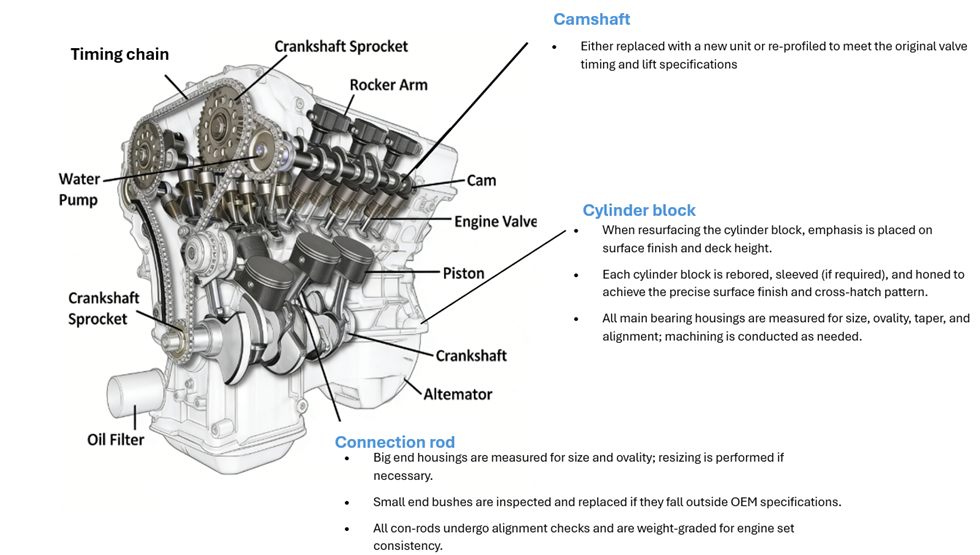
Remanufacturing doesn’t just replace broken parts—it resets the engine to factory-fresh integrity. Every unit undergoes full disassembly, followed by precision inspection using OEM service manuals and dimensional gauges. Components that exceed wear thresholds—crankshafts, camshafts, cylinder heads, and blocks—are either re-machined to original specs or replaced outright. Critical wear items like pistons, rings, bearings, gaskets, and timing components are all new, with many remanufacturers upgrading known weak points (e.g., reinforced timing chain tensioners, improved oil control rings). Cylinder heads are resurfaced, valves lapped or replaced, and guides reamed to restore proper sealing and airflow. Oil passages are ultrasonically cleaned to eliminate residual sludge, and all internal surfaces are inspected for microfractures or warpage. Finally, each engine undergoes dynamic load testing—including Bosch-developed rotational stress protocols—to verify compression, oil pressure, and emissions compliance before shipment. The result is an engine that meets or exceeds OEM performance and durability standards—not a patchwork fix.
Cost Comparison: Reman vs. New, Used, and Rebuilt Engines
2024 Pricing Benchmarks: Reman Audi A4 Engines Cost 45–60% Less Than New
For owners facing engine replacement, remanufactured units offer compelling value without sacrificing assurance. According to Kelley Blue Book’s 2024 Engine Replacement Cost Guide, reman Audi A4 engines typically range from $5,000–$9,000, compared to $12,000–$20,000+ for new OEM powerplants—a 45–60% savings. That gap reflects not just lower material costs, but also the efficiency of reman’s standardized, high-volume process versus low-yield OEM production runs.
Total Cost of Ownership: Factoring in Labor, Warranty Coverage, and Longevity
Labor costs remain consistent across engine types—most Audi specialists charge $1,500–$2,500 for a complete swap on B6/B7 models—but the long-term economics diverge sharply. Reman engines come standard with 3–5 year/unlimited-mile warranties backed by national networks, matching OEM coverage terms. In contrast, rebuilt engines rarely exceed a 1–2 year warranty—and often exclude labor or consequential damage. More critically, longevity data from the Powertrain Validation Institute shows properly installed reman units average 115,000+ miles before major intervention, outperforming both used engines (high uncertainty, no warranty) and most field-built rebuilds (inconsistent quality control, higher failure rates after 60,000 miles). When factoring warranty protection, expected lifespan, and avoided repeat labor, reman delivers the lowest total cost of ownership.
Audi A4-Specific Reman Engine Compatibility and Installation Requirements
VIN-Driven Variants: Matching Reman Engines to B6/B7 Chassis, ECU Generations, and Turbo Configurations
Audi A4 reman engines aren’t one-size-fits-all—even within the same displacement. The B6 (2002–2005) and B7 (2005–2008) platforms differ significantly in ECU architecture (Motronic vs. ME7/MED7), turbo configurations (K03 vs. K04, variable vane actuation), and intake/exhaust port geometry. For example, early 1.8T B6 engines use a different crank position sensor trigger wheel than later 2.0T FSI B7 units, and mismatched ECUs can trigger persistent P0340 codes or limp mode. Similarly, turbo oil feed lines and mounting flanges vary between generations—installing a B7-spec reman into a B6 chassis risks oil starvation or exhaust leak. Reputable remanufacturers cross-reference the vehicle’s full VIN to ensure exact compatibility: correct ECU calibration, wiring harness pinouts, turbo oil line routing, and even transmission bellhousing bolt patterns. This VIN-driven matching preserves plug-and-play installation and eliminates guesswork—or costly rework.
Reliability Verified: How Modern Reman Engines Meet or Exceed OEM Standards
Debunking the 'Rebuilt vs. Reman' Myth with Bosch and Powertrain Validation Data
“Rebuilt” and “remanufactured” sound similar—but they represent fundamentally different standards. A rebuilt engine is typically repaired in situ or by a local shop using whatever parts are on hand, often without full disassembly, machining, or systematic testing. Remanufacturing, by contrast, follows a rigorous, factory-aligned process defined by the Automotive Parts Remanufacturers Association (APRA) and validated by independent powertrain labs. It begins with core teardown and ends with dynamic load testing under real-world torque and RPM profiles—protocols developed in partnership with Bosch and used by Tier 1 suppliers. Crucially, reman facilities integrate Technical Service Bulletin (TSB) updates as standard practice: upgraded tensioners, revised PCV systems, and improved oil filter bypass valves are installed proactively—not after failure occurs.
| Attribute | Remanufactured Engine | Rebuilt Engine |
|---|---|---|
| Component Standards | OEM or better | Variable quality |
| Testing Protocols | Dynamic load testing | Basic functionality |
| Warranty Backing | Comprehensive coverage | Limited or partial |
| Proactive TSB Updates | Standard procedure | Rarely implemented |
This discipline translates directly into reliability: APRA 2025 data confirms reman engines achieve <0.8% warranty claim rates—on par with new OEM units—and support sustainable automotive practices by reducing raw material demand and landfill waste. For aging Audi A4 owners, choosing a certified reman engine means choosing proven engineering, not compromise.
Ready to Optimize Your Audi A4 Fleet & Repair Operations with Certified Remanufactured Engines?
Certified remanufactured engines are the cornerstone of profitable, low-downtime Audi A4 service operations—no other solution delivers the same combination of 45–60% upfront cost savings, OEM-matching reliability, and comprehensive warranty coverage. By choosing remanufactured powertrains, you reduce unplanned downtime, minimize warranty claims, and offer your customers a cost-effective alternative to overpriced new OEM engines.
For ISO 9001-certified remanufactured Audi A4 engines tailored to B2B fleet, repair, and OEM needs, or to establish a custom bulk supply or white-label partnership (as offered by Oruide), partner with a provider rooted in 15+ years of European powertrain expertise. Oruide’s VIN-matched build process, global logistics network, and tiered bulk pricing ensure consistent quality, on-time delivery, and maximum profitability for your operations. Contact us today for a no-obligation bulk quote or technical consultation to transform your Audi engine replacement strategy.
FAQ
What is the difference between remanufactured and rebuilt engines?
Remanufactured engines follow a detailed factory-aligned procedure involving full disassembly, machining, and testing. Rebuilt engines are repaired using available parts but often lack comprehensive testing or adherence to OEM specifications.
Are reman engines compatible with all Audi A4 models?
Reman engines are VIN-matched to ensure compatibility with specific chassis, ECU generations, and turbo configurations, preventing installation errors and costly rework.
How long do remanufactured engines last?
Properly installed remanufactured engines typically last over 115,000 miles, outperforming used and rebuilt engines in terms of reliability and lifespan.
Do reman engines come with a warranty?
Yes, most remanufactured engines include a 3–5 year/unlimited-mile warranty, providing comprehensive coverage.
How do reman engines support sustainability?
Remanufacturing reduces raw material demand and landfill waste by recycling existing engine cores and minimizing resource consumption.