 EN
EN

The BMW B58B30 inline-six 3.0L turbo petrol engine stands as one of the most reliable and high-performance powertrains in BMW’s modern modular engine lineup. Launched to replace the iconic N55 engine, the B58B30 family includes two core variants: the B58B30A (2015–2020) and the updated B58B30C (2015–present). With refined turbo response, outstanding fuel efficiency, and robust power output, these inline-six units have powered countless BMW luxury performance models and even Toyota’s Supra sports car.
For global auto parts wholesalers, independent luxury repair garages, and fleet service partners, the B58B30 series maintains extremely high aftermarket inquiry volume. Though far more durable than older N-series engines, both A and C variants carry unique generation-specific inherent faults that lead to recurring maintenance headaches for high-mileage units. As an experienced remanufacturer specializing in BMW modern engines,Oruide possesses rich hands-on experience rebuilding both B58B30A and B58B30C engines. We excel at targeted failure analysis and root-cause optimization, with mature bulk sale and global export capabilities to support B2B clients with stable, high-quality remanufactured engine solutions.
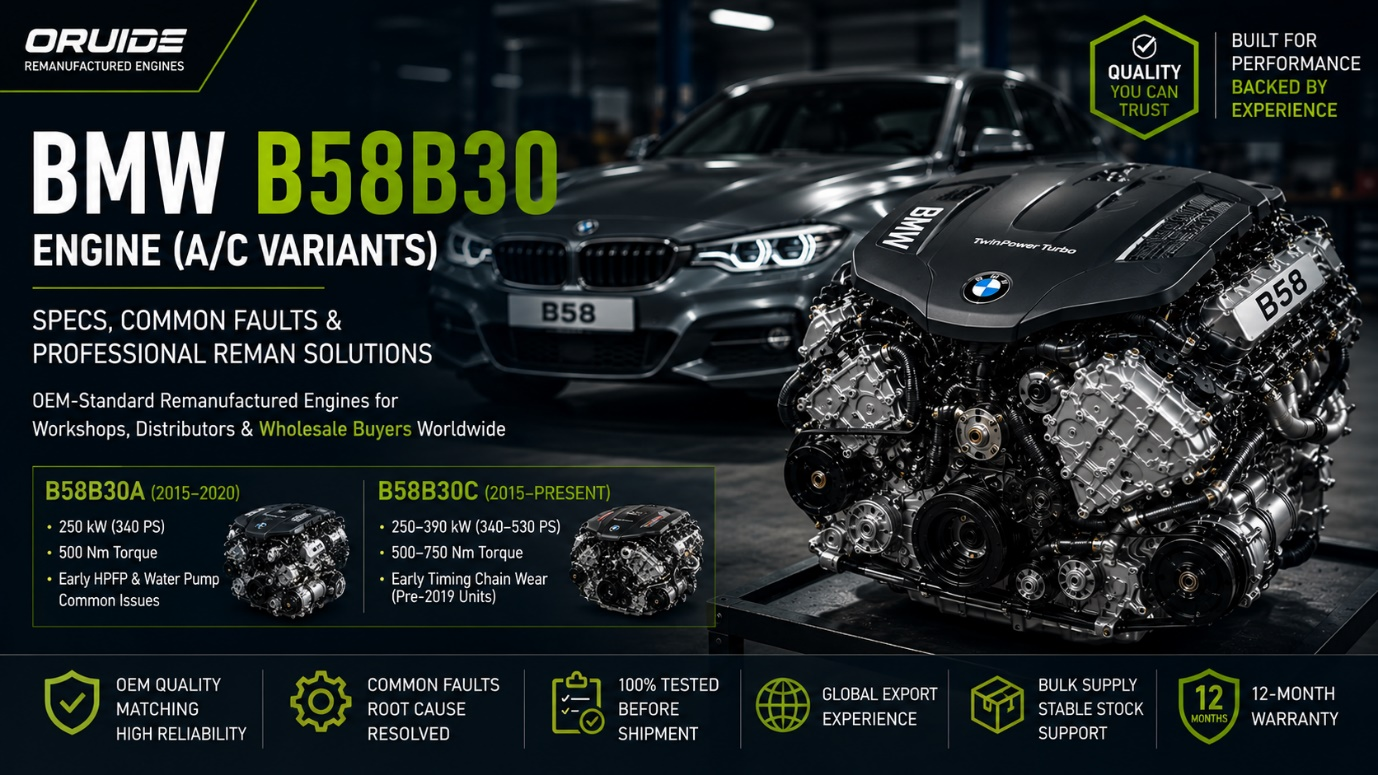
B58B30A vs B58B30C: Technical Overview & Generation Differences
Both variants share the same 2,998cc inline-six DOHC 24-valve layout, paired with BorgWarner twin-scroll turbochargers, 350-bar high-precision direct injection, and BMW’s Valvetronic variable valve lift system. Built with reinforced closed-deck aluminum blocks and forged crankshafts, they deliver smooth linear power and impressive durability while complying with strict Euro 6 emission standards. However, key structural and component upgrades distinguish the two generations, resulting in different reliability weaknesses and aftermarket compatibility.
The B58B30A is the early base generation produced from 2015 to 2020, tuned for a fixed 340 PS / 500 Nm output. It features an electric water pump and traditional timing chain layout, optimized for F-series and early G-series BMW platforms. Its most prominent weakness lies in early high-pressure fuel pump design and degradable plastic water pump impellers.
The updated B58B30C serves as the revised, upgraded iteration, with extended production from 2015 to the present. It supports wider power tuning ranging from 340 PS to 530 PS and 500–750 Nm torque, integrates GPF (gasoline particulate filter) emission technology, and adapts to 48V mild-hybrid systems on late-model G-series vehicles. While improving fuel system stability, it redesigned the timing chain tensioner structure, bringing new wear risks for early pre-2019 production units.
Compatible Vehicle Models for B58B30A & B58B30C
B58B30A (2015–2020)
Primarily fitted to early F30/G30 generation performance models, including BMW 3 Series F30 340i xDrive, 5 Series G30 540i xDrive, X3 G01 M40i, and Z4 G29 sDrive30i. Platform-specific exhaust routing and engine mount adaptations create minor part interchange limitations for aftermarket replacement.
B58B30C (2015–Present)
Widely adopted on updated G-series platforms and cross-brand applications, covering BMW 3 Series G20 M340i, X5 G05 xDrive40i, Z4 G29 M40i, and the Toyota Supra 3.0L J29. Late 2022+ MHEV versions feature revised cooling and ECU calibration, requiring professional matching during engine replacement for wholesale orders.
Parameter |
B58B30A |
B58B30C |
Displacement |
2,998 cc |
2,998 cc |
Fuel type |
Petrol |
Petrol |
Configuration |
Inline-6, DOHC, 24-valve, Valvetronic |
Inline-6, DOHC, 24-valve with Valvetronic IV |
Aspiration |
Turbocharged (twin-scroll) |
Turbocharged (twin-scroll) |
Bore × stroke |
82.0 mm × 94.6 mm |
82.0 mm × 94.6 mm |
Power output |
250 kW (340 PS) @ 5,500–6,500 rpm |
250–390 kW (340–530 PS) |
Torque |
500 Nm @ 1,500–4,500 rpm |
500–750 Nm @ 1,500–5,200 rpm |
Fuel system |
High Precision Injection (direct, up to 350 bar) |
High-pressure direct injection (up to 350 bar) |
Emissions standard |
Euro 6 |
Euro 6 |
Cooling system |
Water-cooled, electric coolant pump |
Water-cooled with electric thermostat |
Turbocharger |
Single twin-scroll turbo (BorgWarner) |
Single twin-scroll turbo (BorgWarner) |
Timing system |
Chain (front-mounted, dual-row) |
Chain (front-mounted; wear-prone in early units) |
Oil type |
BMW Longlife-01 (SAE 5W-30) |
BMW Longlife-04 (SAE 5W-30) |
Dry weight |
184 kg |
184 kg |
12 months |
12 months |
Common Reliability Issues & Root Cause Analysis (A/C Variant Specific)
Although the B58 series is recognized as BMW’s most reliable modern inline-six engine, generation-specific design flaws lead to concentrated failure points on high-mileage or poorly maintained vehicles. Ordinary partial repairs only solve surface problems, resulting in high revisit rates and increased operational pressure for B2B repair and wholesale partners.
1. B58B30A Exclusive: Early HPFP Failure & Water Pump Degradation
Pre-2017 B58B30A units suffer from premature high-pressure fuel pump mechanical wear, a confirmed issue in BMW official service bulletin 13 01 19. Sustained high-load driving and extended oil change intervals accelerate internal pump fatigue, triggering engine hesitation, random misfires, hard starting, and fuel pressure-related DTC faults. Additionally, the factory plastic water pump impeller degrades over time, reducing coolant flow efficiency and causing idle overheating and temperature fluctuation failures.
2. B58B30C Exclusive: Early Timing Chain & Tensioner Wear
The most typical flaw for pre-2019 B58B30C engines is timing chain system aging, recorded in BMW SIB 11 52 20. The original early-design plastic guide rails and tensioners lack sufficient low-temperature lubrication performance. Frequent short-trip urban driving leads to cold-start lubrication insufficiency, causing chain slack, cold-start rattling noise, and cam/crank timing correlation faults. In severe cases, it triggers engine shutdown or secondary mechanical damage.
3. Universal Faults for Both Variants
Intake Valve Carbon Buildup: As a pure direct-injection engine, the B58 series lacks port fuel cleaning effects. Oil vapor from the PCV system accumulates on intake ports over time, causing rough idle, acceleration hesitation, reduced power, and increased fuel consumption, a common aging issue for all high-mileage units.
Turbo Actuator & Wastegate Malfunction: Long-term high-temperature operation causes carbon deposition and mechanical sticking of the turbo actuator, leading to boost pressure deviation, over/under-boost fault codes, and vehicle limp mode under load.
Oil Seal & Cover Leakage: Aging valve cover gaskets and timing cover seals gradually harden under thermal cycling, resulting in minor oil seepage. Sustained crankcase pressure anomalies will worsen leakage and produce obvious burning oil smells.
Oruide’s B58B30 Remanufacturing & Wholesale Export Advantages
With years of in-depth remanufacturing experience on BMW B58B30A and B58B30C full-series engines, Oruide’s technical team has summarized complete fault optimization solutions targeting generation-specific defects. Different from ordinary refurbished engines, our remanufacturing process discards flawed original components and adopts upgraded revised parts to eliminate recurring faults fundamentally.
We have long-term stable bulk sale and global export capabilities, serving auto parts wholesalers, luxury repair chains, and fleet service clients across Europe, North America, and Southeast Asia. We provide complete export certification, standardized anti-corrosion shockproof packaging, and flexible batch order solutions, helping B2B partners reduce procurement costs and after-sales failure rates while improving market competitiveness.
Standard Oruide Remanufacturing Process for B58B30 Engines
1. Full Disassembly & Precision Detection: Complete engine teardown, industrial deep cleaning and inspection of all core components. Screen and eliminate worn timing systems, fuel pumps, turbo actuators, cooling parts, and aging sealing components.
2. Targeted Upgraded Replacement: For B58B30A, replace early faulty HPFP and plastic water pumps with revised OEM-spec upgraded parts. For B58B30C, install reinforced metal timing tensioner and guide kits to solve cold-start chain wear. Renew all gaskets, seals, and PCV system components universally.
3. Precision Machining & Standard Assembly: Restore cylinder blocks, cylinder heads, and crankshafts to factory tolerances through professional CNC machining. Assemble strictly in accordance with BMW official torque standards in a dust-free constant-temperature workshop.
4. System Calibration & Hot Bench Testing: Precisely calibrate fuel injection, turbo boost, and Valvetronic systems. Conduct hours of full-load hot testing to ensure stable idle, consistent power output, zero leakage, and fault-free operation.
5. Export-Grade Packaging & Shipping: Apply professional rust prevention treatment and reinforced export packaging to adapt to long-distance cross-border transportation for global wholesale clients.
B2B Customer FAQ
Q1: What is the core difference between remanufactured B58B30A and B58B30C engines from Oruide?
A: We adopt targeted optimization for generation-specific flaws. B58B30A units are upgraded with improved fuel pumps and cooling components to eliminate HPFP and water pump faults. B58B30C units are equipped with reinforced timing kits to solve chain wear problems. All units are strictly matched with original vehicle platform parameters to ensure perfect compatibility.
Q2: Is bulk wholesale ordering supported for B58B30 series engines?
A: Yes. Oruide maintains stable inventory of B58B30A and B58B30C remanufactured engines, supporting customized bulk sales and long-term cooperative supply for global dealers and repair chains, with complete export documents and reliable after-sales technical support.
Q3: Why choose remanufactured B58 engines instead of second-hand stock engines?
A: Second-hand engines retain original design flaws and have unpredictable hidden faults. Oruide’s remanufactured engines optimize all common failure points through component upgrades and system recalibration, with far lower failure rates, helping B2B partners reduce after-sales disputes and improve long-term profitability.
The BMW B58B30 series is undoubtedly one of the most cost-effective and high-value replacement engines in the current luxury performance aftermarket. While its overall reliability surpasses older N-series engines, generation-specific HPFP, timing chain, cooling, and carbon buildup issues still bring stable aftermarket replacement demand. For B2B wholesalers and professional repair workshops, choosing Oruide’s defect-optimized remanufactured B58B30A/B30C engines can effectively reduce maintenance repetition and operational risks. With professional remanufacturing technology, rich fault-solving experience, and mature global bulk export capabilities, Oruide continues to deliver high-quality, cost-effective engine solutions for global aftermarket partners.
Get a Fast Quote
Ready to source high-quality remanufactured engines from a reliable engine supplier? Fill out our form to get a customized quote within 24 hours. We’ll help you select the right engine model, confirm MOQ, and outline delivery timelines, so you can source with confidence.