 EN
EN
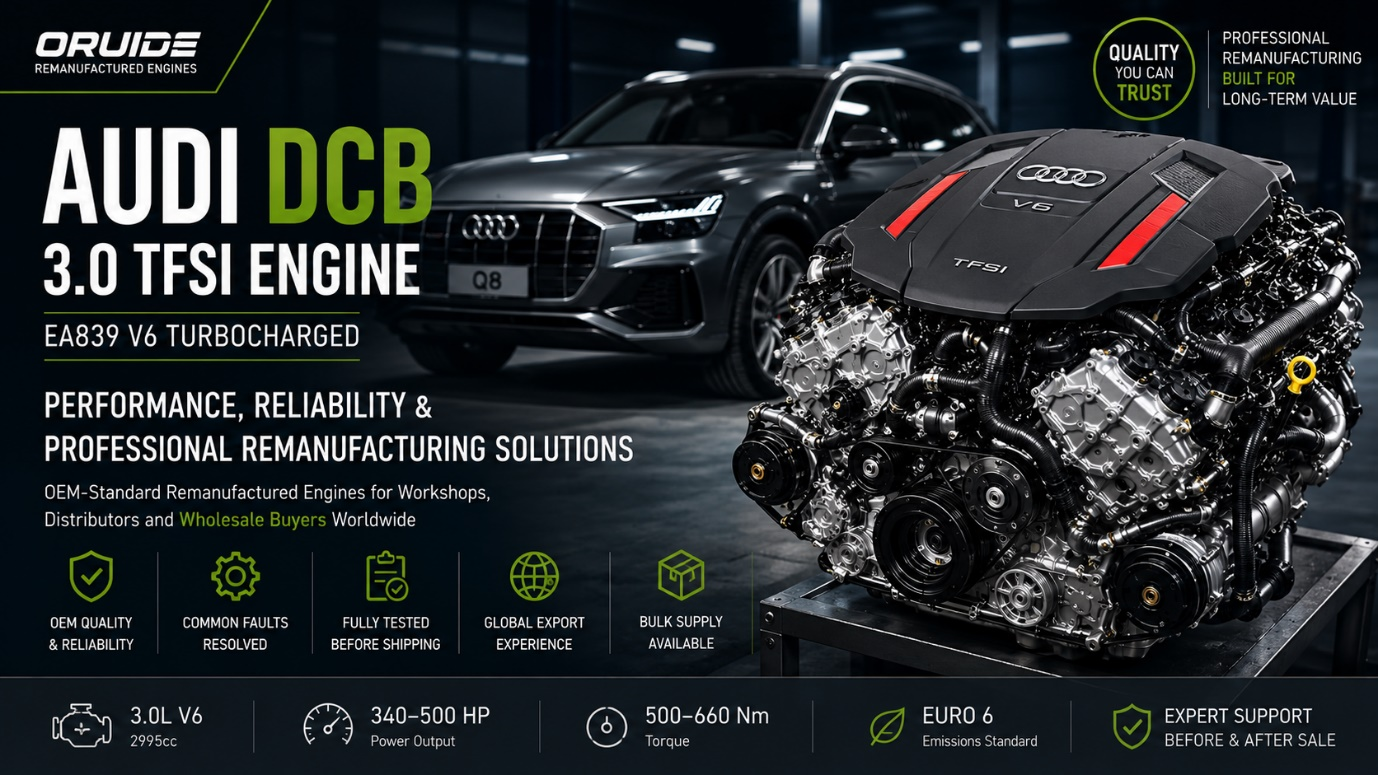
The Audi DCB engine is one of the representative 3.0 TFSI V6 turbocharged engines from the Volkswagen Group’s modern high-performance powertrain family. Designed to deliver strong power output, smooth driving performance, and improved efficiency, the DCB engine has been widely used in premium Audi models, including SUVs and performance-oriented vehicles.
For vehicle repair workshops, engine rebuilders, parts distributors, and wholesale buyers, understanding the technical characteristics and common failure points of the Audi DCB engine is essential. Unlike conventional engine replacement, sourcing a remanufactured DCB engine requires accurate technical knowledge, professional inspection processes, and a reliable supply partner to ensure long-term performance and customer satisfaction.
Audi DCB Engine Overview and Technical Characteristics
The Audi DCB engine is a 3.0L V6 turbocharged petrol engine based on the Volkswagen Group EA839 engine platform. It combines direct fuel injection, turbocharging technology, and advanced thermal management systems to achieve high power density while meeting strict emission requirements.
Key specifications include:
Parameter |
Value |
Displacement |
2995 cc (3.0L) |
Fuel type |
Petrol / Gasoline |
Configuration |
V6, DOHC, 24-valve |
Aspiration |
Turbocharged |
Bore × stroke |
84.5 mm × 89.0 mm (approx.) |
Power output |
250–368 kW (340–500 hp), depending on application |
Torque |
500–660 N·m, depending on application |
Fuel system |
Direct Injection (FSI), high-pressure fuel injection |
Emissions standard |
Euro 6 / China 6 (depending on market and vehicle application) |
Compression ratio |
Approx. 11.0:1 |
Cooling system |
Water-cooled, integrated thermal management system |
Turbocharger |
Single twin-scroll turbocharger (hot-V layout) |
Timing system |
Timing chain, front-mounted chain drive |
Oil type |
SAE 0W-30 / 5W-30 fully synthetic engine oil (VW 504 00 / 507 00 or equivalent, depending on specification) |
Dry weight |
Approx. 180–190 kg |
Typical Applications |
Audi Q7 55 TFSI, Audi Q8 55 TFSI, Audi A6 55 TFSI, Audi A7 55 TFSI, Audi A8 55 TFSI |
Note: DCB is an engine code within the Audi/VW EA839 3.0 TFSI V6 platform. Exact power output, emission standard, turbo configuration, and oil specification may vary depending on vehicle model, market, and production year. For remanufactured engine matching, VIN code confirmation is recommended.
The DCB engine is designed for high-performance applications, which means its internal components operate under high temperature and high pressure conditions. For this reason, professional remanufacturing requires much more than replacing damaged parts. A complete understanding of the original engineering design and common failure mechanisms is critical.
Common Audi DCB Engine Failure Points and Remanufacturing Solutions
During long-term operation, Audi DCB engines may experience several common issues related to high-performance operation.
1. Carbon Deposits on Intake Valves
Because the DCB engine uses direct injection technology, fuel does not pass through the intake valves to clean deposits. Over time, carbon buildup may affect airflow efficiency, resulting in rough idle, reduced power output, and increased fuel consumption.
During professional remanufacturing, Oruide performs complete engine inspection and evaluates intake system conditions. Components affected by carbon deposits are professionally cleaned or replaced according to wear conditions to restore stable combustion performance.
2. Turbocharger and Lubrication System Wear
The turbocharger system operates under extreme rotational speed and temperature conditions. Insufficient lubrication or extended maintenance intervals may accelerate wear of turbocharger-related components.
Oruide’s remanufacturing process includes detailed inspection of lubrication channels, oil pressure systems, and turbocharger-related components. Any component outside factory tolerance is replaced or restored to ensure reliable operation after installation.
3. Cooling System and Thermal Management Issues
High-performance V6 engines rely heavily on efficient cooling systems. Aging cooling components or improper maintenance can lead to thermal stress, which may affect cylinder heads, seals, and internal engine components.
During the remanufacturing process, Oruide conducts dimensional inspection of major components and performs pressure testing to ensure cooling system reliability.
Oruide Professional Audi DCB Remanufacturing Process
As an experienced remanufactured engine supplier with international export experience, Oruide applies a complete industrial remanufacturing process rather than simple engine repair.
The standard process includes:
1. Complete Engine Disassembly and Inspection
Each Audi DCB engine is fully disassembled. Cylinder blocks, cylinder heads, crankshafts, pistons, turbo-related components, and other critical parts are inspected using professional measurement equipment.
2. Precision Machining and Component Restoration
Engine blocks and cylinder heads are restored according to OEM dimensional requirements. Key components are repaired or replaced based on wear analysis to ensure durability and consistent performance.
3. Assembly According to Technical Standards
After machining, engines are assembled following strict technical procedures. Torque specifications, clearance measurements, and assembly sequences are carefully controlled to maintain original engine performance.
4. Testing and Quality Validation
Before shipment, each remanufactured DCB engine undergoes functional testing, including leak inspection, system verification, and performance validation.
This process allows Oruide to provide reliable remanufactured Audi engines for global customers, including automotive workshops, wholesale distributors, and vehicle service networks.
Reliable Supply Solution for Wholesale and Bulk Buyers
For businesses purchasing engines internationally, product quality is only one part of the decision. Stable supply capability, technical support, and export experience are equally important.
Oruide has supported international customers with remanufactured engine solutions for European and global markets. Through cooperation with repair networks, distributors, and automotive businesses, Oruide understands the importance of accurate engine matching, documentation support, and consistent delivery.
For bulk orders, Oruide can provide customized technical confirmation based on vehicle information, engine specifications, and customer requirements, helping buyers reduce installation risks and improve customer satisfaction.
FAQ About Audi DCB Remanufactured Engines
Q1: Is a remanufactured Audi DCB engine the same as a used engine?
No. A used engine is typically sold in its original condition without complete inspection or restoration. A remanufactured DCB engine is professionally disassembled, inspected, restored, tested, and rebuilt according to technical standards.
Q2: Who should consider purchasing Audi DCB remanufactured engines?
Remanufactured DCB engines are suitable for automotive repair workshops, engine rebuilders, vehicle parts distributors, and wholesale buyers looking for reliable replacement solutions.
Q3: How can buyers confirm the correct DCB engine version?
Engine compatibility should be confirmed through vehicle VIN information, engine code, vehicle model, and production year. This prevents installation issues caused by different configurations.
Q4: Can Oruide support bulk orders for Audi DCB engines?
Yes. Oruide provides wholesale supply solutions for international customers, including technical confirmation, export documentation, and customized remanufacturing support.
Ready to source high-quality remanufactured engines from a reliable engine supplier? Fill out our form to get a customized quote within 24 hours. We’ll help you select the right engine model, confirm MOQ, and outline delivery timelines, so you can source with confidence.