
 EN



The BMW B48 is a modular turbocharged four-cylinder gasoline engine family introduced in the mid-2010s as the successor to the N20/N26 generation in many BMW applications. It is part of BMW Group’s modular engine architecture and is used across a wide range of BMW and MINI models, with both transverse and longitudinal installation layouts depending on the vehicle platform.
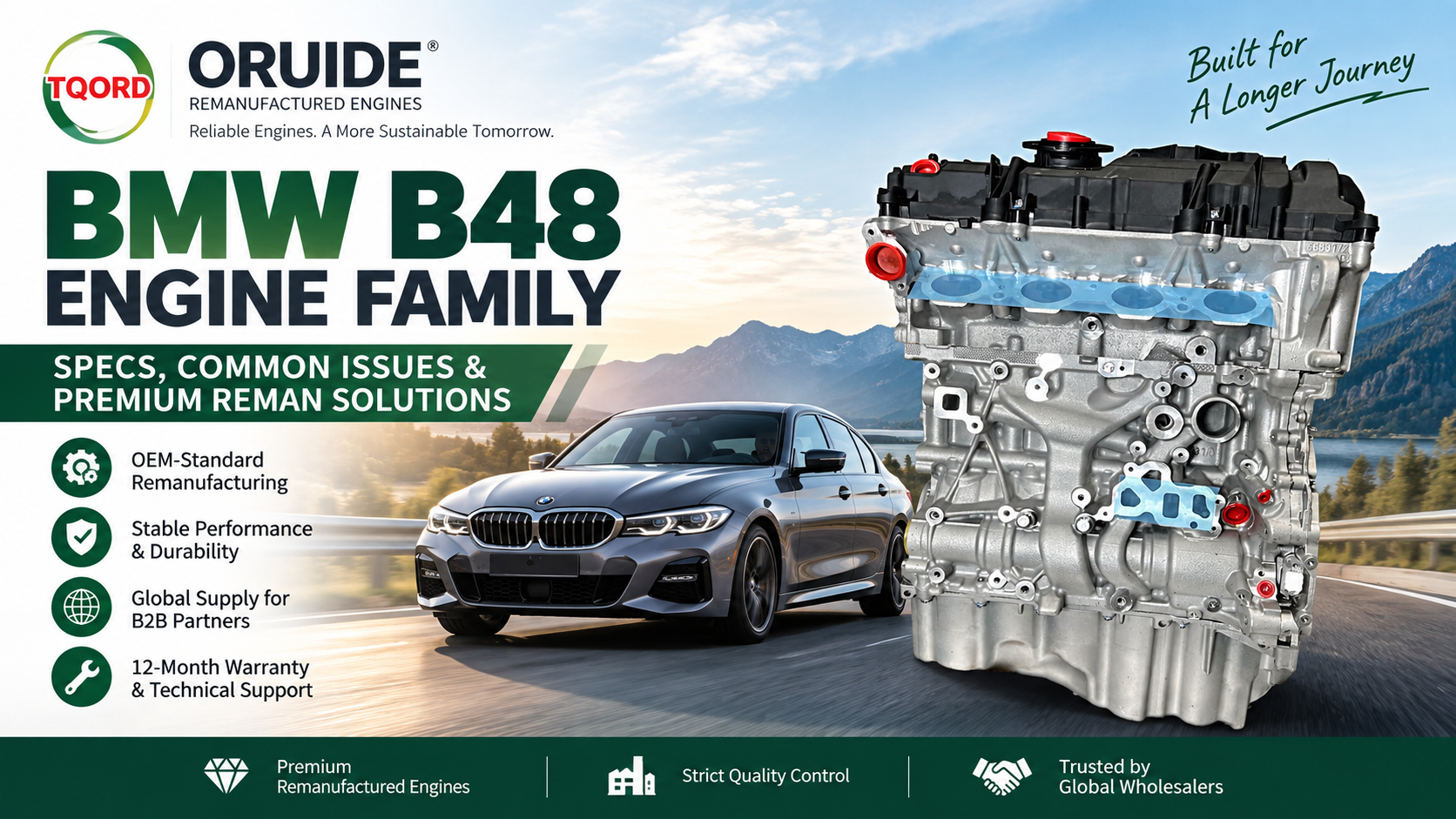
The B48 family is built around an aluminum four-cylinder architecture and combines turbocharging, High Precision direct injection, Valvetronic variable valve lift, and Double VANOS variable camshaft timing. Most mainstream versions are 1,998 cc, while a less common 1,597 cc four-cylinder version also exists in selected markets. Depending on generation, market and emissions specification, fuel-system pressure, exhaust aftertreatment, calibration and auxiliary systems can differ significantly.
This variation is important in the replacement-engine business. A B48 engine should not be selected only by the broad ‘B48’ family name: exact engine designation, vehicle VIN, model year, installation layout, emissions specification and ancillary configuration should be verified before quotation and production.
For global auto-parts distributors, repair chains, engine wholesalers and other B2B buyers, the B48 has become an important replacement-engine family because of its broad installed base. Oruide provides remanufactured B48 engines for wholesale, recurring procurement and international export, with configuration verification and failure-oriented inspection built into the remanufacturing process.
Full Technical Specifications of BMW B48 Main Variants
The B48 family uses a common modular architecture, but exact output, fuel-system pressure, emissions equipment and installation layout vary by generation and vehicle application. The table below is intended as a sourcing reference rather than a substitute for VIN-level verification.
Parameter |
B48 1.6L Variant |
B48 2.0L Gen 1 – Standard Output |
B48 2.0L Gen 1 – Higher Output |
B48 2.0L TU – Standard Output |
B48 2.0L TU – Higher Output |
Displacement |
1,597 cc, inline-4 |
1,998 cc, inline-4 |
1,998 cc, inline-4 |
1,998 cc, inline-4 |
1,998 cc, inline-4 |
Bore × Stroke |
82.0 × 75.6 mm |
82.0 × 94.6 mm |
82.0 × 94.6 mm |
82.0 × 94.6 mm |
82.0 × 94.6 mm |
Aspiration |
Turbocharged; application-dependent turbo specification |
Single twin-scroll turbocharger |
Single twin-scroll turbocharger |
Single twin-scroll turbocharger |
Single twin-scroll turbocharger |
Power Output |
Application-dependent |
Typically around 135 kW / 184 PS in common applications |
Application-dependent; higher-output calibrations available |
Application-dependent |
Application-dependent; high-output versions available |
Torque |
Application-dependent |
Typically around 270–300 Nm in common applications |
Application-dependent |
Application-dependent |
Application-dependent; up to approximately 450 Nm in selected versions |
Fuel System |
High-pressure gasoline direct injection |
High-pressure gasoline direct injection; early-generation systems typically up to 200 bar |
High-pressure gasoline direct injection; early-generation systems typically up to 200 bar |
Revised High Precision direct injection; B48TU systems up to 350 bar |
Revised High Precision direct injection; B48TU systems up to 350 bar |
Valvetrain |
DOHC, 16-valve, Double VANOS, Valvetronic |
DOHC, 16-valve, Double VANOS, Valvetronic |
DOHC, 16-valve, Double VANOS, Valvetronic |
DOHC, 16-valve, Double VANOS, Valvetronic |
DOHC, 16-valve, Double VANOS, Valvetronic |
Timing System |
Chain-driven |
Chain-driven |
Chain-driven |
Revised chain-drive architecture on TU generation |
Revised chain-drive architecture on TU generation |
Emissions |
Market/model-year dependent |
Euro 6 / market-dependent equivalent |
Euro 6 / market-dependent equivalent |
Euro 6d / market-dependent equivalent; GPF used where required |
Euro 6d / market-dependent equivalent; GPF used where required |
Warranty |
12 months / Customized terms available for qualified B2B orders |
||||
Note: BMW engine designations such as B48A20, B48B20 and their suffixes identify different technical/application variants. Output and equipment can vary by market and production date. For B2B sourcing, Oruide recommends confirming the VIN and exact engine code before quotation.
Compatible Vehicle Models for B48 Full Series
Different B48 variants are used in both transverse and longitudinal BMW Group platforms. Typical applications include the following; exact engine designation must be confirmed by VIN because the same vehicle family may use different B48 variants by market, model year and output level:
- BMW 1 Series and 2 Series: selected F-series and F40/F44 gasoline models.
- BMW 3 Series and 4 Series: selected F30/F31/F34/F32 and G20/G21/G22 gasoline models, including common 20i/30i applications depending on market.
- BMW X1 and X2: selected F48 X1 and F39 X2 gasoline models.
- BMW X3 and X4: selected G01 X3 and G02 X4 four-cylinder gasoline models.
- BMW Z4: selected G29 four-cylinder gasoline versions.
- MINI: selected F54/F55/F56/F57/F60 Cooper S and JCW applications depending on market and production year.
- Toyota GR Supra: selected 2.0L versions use a BMW-sourced B48-family four-cylinder engine.
High-performance six-cylinder models such as the BMW M340i use the B58 rather than the B48. Therefore, model names alone should not be used to determine engine compatibility.
Common Reliability Issues & Root Cause Analysis of B48 Engines
The B48 is generally regarded as a robust modern BMW gasoline engine, but high-mileage units can still develop recurring faults. The probability and root cause vary by engine generation, vehicle application, maintenance history and operating conditions, so the following issues should be treated as inspection priorities rather than universal factory defects.
1. High-Pressure Fuel-System Faults
The B48 uses high-pressure direct injection. Depending on generation, the system operates with different pump and injector designs, and B48TU versions increased maximum injection pressure to 350 bar from the earlier 200-bar architecture. Hard starting, misfire under load, fuel-pressure faults and loss of power can be related to the high-pressure pump, injectors, sensors or fuel supply. A correct diagnosis should therefore verify actual and target rail pressure and related fuel-system data rather than assuming the HPFP is always the root cause.
2. Timing Chain, Guide & Tensioning-System Wear
The B48 uses a chain-driven camshaft system. Wear can occur with mileage, poor lubrication history or extended oil-service intervals. Cold-start rattle, timing correlation faults or abnormal chain noise should trigger inspection of the chain, guides, tensioning components and camshaft timing system. The later B48TU generation also introduced a revised chain-drive architecture, so parts should be matched to the exact engine generation.
3. Intake Valve Carbon Deposition
B48 engines use direct gasoline injection, which means fuel is injected into the combustion chamber rather than across the back of the intake valves. Oil vapor and blow-by contamination can therefore contribute to intake-valve deposits over time. Excessive buildup may contribute to rough idle, airflow restriction, misfire or reduced response. Deposit severity varies considerably with mileage and operating pattern, so cleaning should be based on inspection rather than a fixed interval.
4. Cooling-System Aging & Coolant Leakage
As B48-equipped vehicles age, cooling-system components, seals, hoses and plastic housings can become sources of coolant loss. Water-pump, thermostat or heat-management faults can also affect temperature control on some applications. Any engine that has experienced overheating or prolonged coolant loss should receive additional inspection for cylinder-head sealing, distortion and secondary thermal damage during remanufacturing.
5. Turbocharger Control & Oil Leakage
Turbocharger wastegate or actuator faults can cause boost-control deviations, while aging gaskets and seals can lead to external oil leakage. These symptoms should be diagnosed as a system because boost faults may also originate from air leaks, sensors or control components. During remanufacturing, Oruide evaluates the original failure mode and related components rather than replacing only the visibly damaged part.
Oruide B48 Engine Remanufacturing Process & B2B Wholesale Advantages
Oruide has practical experience in BMW gasoline-engine remanufacturing and cross-border B2B supply. For B48 engines, the objective is not simply to replace the failed component, but to identify the failure path, inspect related systems and rebuild the engine to a consistent specification suitable for wholesale and recurring procurement.
The process begins with complete disassembly, cleaning and dimensional inspection of critical components. The cylinder block, cylinder head, crankshaft, connecting rods, pistons and other reusable components are evaluated against the required dimensional and functional criteria. Components outside specification are machined, repaired or replaced as appropriate.
Failure-oriented inspection is then applied according to the engine condition. Timing-related engines receive detailed inspection of the chain drive and lubrication condition; overheating cases receive additional cylinder-head and sealing-surface checks; fuel-system or combustion complaints are evaluated together with the relevant injection and intake components. Intake deposits are cleaned where required, and aging gaskets, seals and other specified wear components are renewed during assembly.
The engine is assembled under controlled workshop procedures using calibrated torque tools. Critical clearances, fastener tightening, timing alignment and sealing conditions are verified throughout assembly.
Cold-Test Bench Validation
After assembly, Oruide uses cold-test bench validation as the principal end-of-line verification method for remanufactured engines. Cold testing allows key mechanical and functional parameters to be checked without combustion and is well suited to identifying assembly, sealing, lubrication and synchronization abnormalities before shipment.
- Oil-pressure generation and lubrication response
- Engine sealing and leakage
- Crankshaft rotational characteristics and starter load
- Camshaft-to-crankshaft synchronization
- Relevant sensor signals and timing-related data
- Other model-specific parameters available through the cold-test setup
Test scope is matched to the engine configuration. Engines that pass the required checks then undergo final inspection and export-oriented packaging.
For B2B customers, Oruide supports small-batch trial orders, recurring wholesale procurement, bulk supply, export packaging, configuration verification and inventory cooperation. Because B48 specifications vary by vehicle and market, our quotation process prioritizes engine code and VIN verification to reduce compatibility and after-sales risk for distributors and repair networks.
FAQ – Frequently Asked Questions About BMW B48 Engines
Q1: Are all B48 engines 2.0L?
A: No. Most widely used B48 versions are 1,998 cc four-cylinder engines, but a 1,597 cc four-cylinder B48 variant also exists in selected markets. The B48 should not be confused with BMW’s B38, which is the three-cylinder member of the modular gasoline-engine family.
Q2: What changed with the B48TU technical update?
A: The technical update introduced multiple design revisions. One important change was the fuel system: BMW documentation for B48TU describes a maximum injection pressure of 350 bar, compared with 200 bar on the previous-generation architecture. The timing-chain layout was also revised. Exact equipment still varies by application and market.
Q3: What is the biggest advantage of Oruide remanufactured B48 engines compared with ordinary used engines?
A: Oruide applies complete disassembly, dimensional inspection, failure-oriented diagnosis, controlled assembly and cold-test validation. For professional buyers, this provides a more standardized sourcing process than purchasing used engines with unknown operating and maintenance histories.
Q4: Does Oruide support bulk wholesale and global export of B48 remanufactured engines?
A: Yes. Oruide supports trial orders, recurring wholesale procurement and bulk export for engine distributors, auto-parts wholesalers, repair chains and trading companies. Export packaging, configuration verification and supporting documentation can be arranged according to the project.
Q5: What information should a B2B buyer provide for a B48 quotation?
A: Please provide the engine code, vehicle model, model year, destination market, estimated quantity and VIN whenever available. VIN-level verification is especially important for B48 sourcing because installation layout, output, emissions equipment and ancillary components can differ between variants.
Q6: How can B48 service life be improved?
A: Use the BMW-approved engine-oil specification and fuel grade required for the exact vehicle, maintain the cooling and crankcase-ventilation systems, and investigate abnormal oil consumption, coolant loss, timing noise or fuel-pressure faults promptly. Service requirements vary by model and market, so the vehicle manufacturer’s maintenance specification should take priority over a generic oil grade or fixed octane recommendation.
Ready to source high-quality remanufactured engines from a reliable engine supplier? Fill out our form to get a customized quote within 24 hours. We’ll help you select the right engine model, confirm MOQ, and outline delivery timelines, so you can source with confidence.