 EN
EN

The Suzuki G16B is a well-established 1.6L inline-four naturally aspirated gasoline engine widely used in Suzuki compact cars, SUVs and off-road vehicles across multiple international markets.
Featuring a SOHC 16-valve configuration, multi-point fuel injection and timing-belt-driven camshaft, the G16B combines relatively simple mechanical construction with good serviceability and long-term durability. Its 1,590 cc displacement, compact design and broad vehicle application have also helped maintain demand for G16B replacement engines in the global aftermarket.
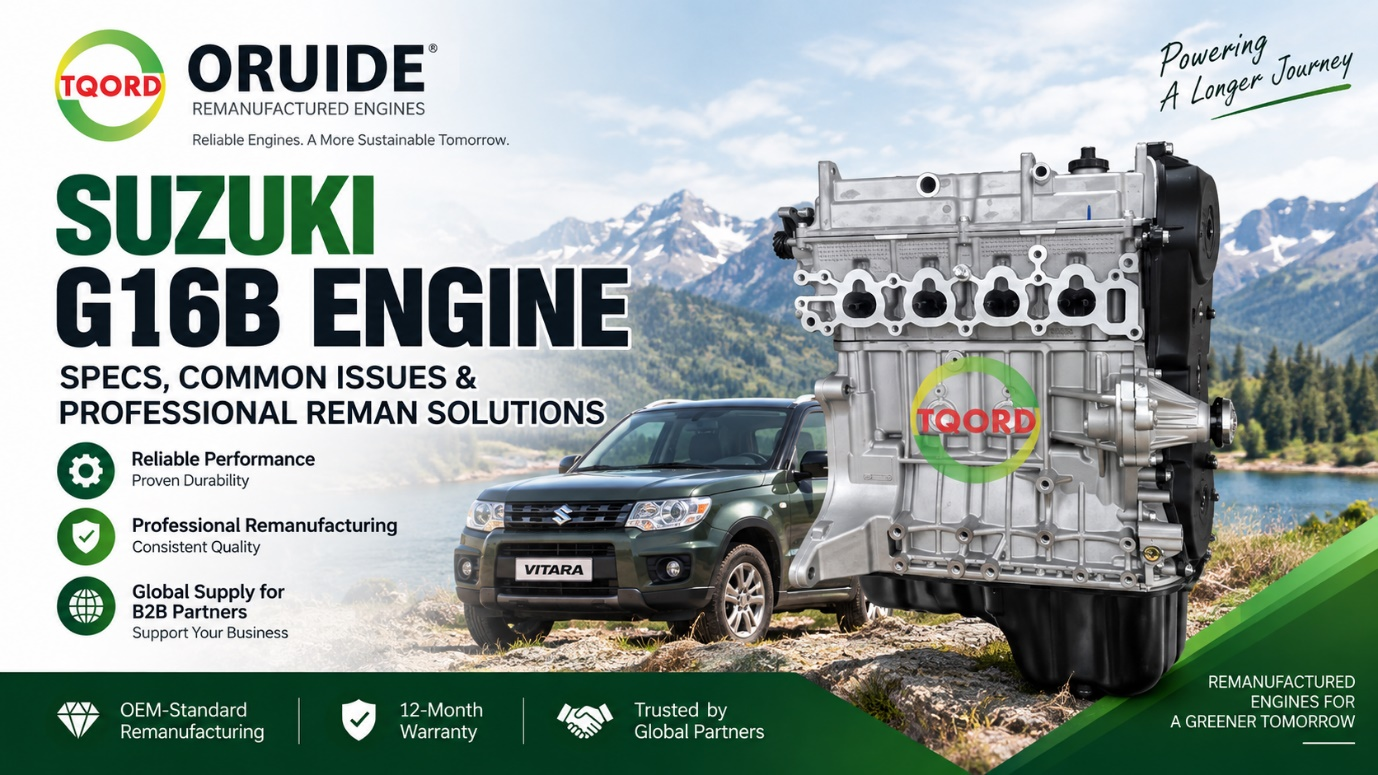
For global auto parts distributors, repair chain operators and B2B aftermarket partners, the Suzuki G16B remains relevant particularly in markets where older Suzuki vehicles continue to operate in significant numbers.
As these engines accumulate mileage and age, however, their condition increasingly depends on maintenance history, cooling-system condition, timing-belt service and internal engine wear. Used engines of unknown history can therefore create additional warranty and after-sales risks for professional buyers.
For B2B customers requiring more consistent replacement-engine quality, Oruide provides professionally remanufactured G16B engines supported by component inspection, dimensional verification, controlled assembly and final testing.
Suzuki G16B Full Technical Specifications
Parameter |
Value |
Displacement |
1.6L |
Fuel Type |
Gasoline |
Configuration |
Inline-4, SOHC, 16-valve |
Aspiration |
Naturally aspirated |
Bore × Stroke |
75.0 mm × 90.0 mm |
Compression Ratio |
Approx. 9.5:1 on common G16B versions |
Torque |
Approx. 132–140 Nm, depending on application |
Power Output |
Approx. 68–72 kW (92–98 hp), depending on market/application |
Fuel System |
MPFI; configuration varies by market/application |
Emissions Standard |
Varies by model year and destination market |
Cooling System |
Liquid-cooled |
Turbocharger |
None |
Timing System |
Timing belt with belt tensioner |
Oil Type |
Follow applicable Suzuki specification; viscosity depends on operating temperature and vehicle application |
Engine Weight |
Varies according to engine configuration and installed accessories |
12 months / Customized terms available for qualified B2B orders |
The G16B’s 1,590 cc displacement comes from a 75.0 mm bore and 90.0 mm stroke, with a commonly cited compression ratio of approximately 9.5:1. Typical production versions produce approximately 68–72 kW, although exact output varies according to vehicle, model year and destination market.
For wholesale replacement-engine procurement, these figures should therefore be treated as family-level reference data. Vehicle application, engine code, model year and VIN should be verified before final engine configuration and quotation.
Suzuki G16B Compatible Vehicles
Make |
Production Years |
Models & Variants |
Suzuki |
1992–2005 |
Vitara / Escudo 1.6L applications |
Suzuki |
1998–2005 |
Grand Vitara 1.6L |
Suzuki |
1995–2002 |
Baleno / Esteem 1.6L applications |
Suzuki |
Market-dependent |
Swift / Cultus 1.6L applications |
Chevrolet / Geo |
Market-dependent |
Tracker 1.6L applications |
The G16B was used across several Suzuki platforms and was also supplied in vehicles sold under different brands in certain markets. Published application data includes Vitara, Grand Vitara, Baleno/Esteem, Swift/Cultus and Tracker applications.
However, vehicle model alone should not be considered sufficient for replacement-engine identification. Differences in intake and exhaust systems, ignition configuration, sensors, accessories and regional vehicle specifications may exist.
For distributors and professional repair networks, Oruide therefore recommends confirming the engine code, vehicle information and VIN before final quotation.
Common G16B Failure Points & Professional Root Cause Analysis
Although the Suzuki G16B has a relatively straightforward and durable design, aging and high-mileage engines can develop several problems that are particularly relevant when evaluating cores for professional remanufacturing.
1. Cylinder Head Gasket and Overheating-Related Damage
Cylinder-head-gasket problems can occur on older G16B engines, particularly where the engine has previously experienced overheating, coolant loss or inadequate cooling-system maintenance.
Continued operation after overheating can result in gasket deterioration, coolant and oil contamination, reduced compression or cylinder-head distortion.
For this reason, a professional remanufacturing process should not simply replace a failed head gasket. The cylinder head, sealing surfaces and cooling system should also be inspected to determine whether overheating has caused secondary damage.
2. Timing Belt and Tensioner Deterioration
Unlike the timing-chain description sometimes associated incorrectly with the G16B, this engine uses a timing belt and belt tensioner.
Aging belts, tensioners and related timing components should therefore receive particular attention on high-mileage engines or engines with unknown service history.
During remanufacturing, the complete timing drive should be inspected and the belt and related wear components replaced according to the applicable remanufacturing specification.
3. Valve Clearance and Valve-Train Wear
The G16B SOHC 16-valve cylinder head requires correct valve-clearance control. Published service specifications include defined intake and exhaust valve clearances, making valve-train inspection an important part of engine servicing and remanufacturing.
Incorrect clearance or valve-train wear may contribute to abnormal mechanical noise, poor combustion or reduced engine performance.
During remanufacturing, Oruide inspects the camshaft, valves, valve seats and related components and restores valve clearances according to the applicable technical specification.
4. Cooling-System Aging
On older G16B applications, cooling-system deterioration can increase the risk of overheating.
Thermostats, water pumps, hoses, sealing surfaces and coolant passages should therefore be evaluated as part of root-cause analysis when a core engine shows evidence of previous overheating.
This is particularly important for wholesalers and repair businesses because simply replacing the visibly failed component may not resolve secondary damage caused by prolonged thermal stress.
For B2B engine buyers, the important distinction is therefore not whether every G16B develops the same “factory defect,” but whether the remanufacturing process correctly identifies the actual failure mechanism of each core engine.
Oruide has experience in Suzuki gasoline engine remanufacturing and international engine supply. Our G16B remanufacturing process focuses on identifying wear and failure causes before determining which components require machining, repair or replacement.
Oruide Professional G16B Remanufacturing Process & B2B Service Advantages
With experience in Suzuki gasoline engine remanufacturing and international B2B engine supply, Oruide provides remanufactured G16B solutions for wholesalers, automotive parts distributors and professional repair networks.
Our standardized G16B remanufacturing process begins with complete engine disassembly and cleaning.
The cylinder block, cylinder head, crankshaft, connecting rods and other critical components are inspected and dimensionally measured. Components outside acceptable specifications are machined, repaired or replaced according to their condition.
The cylinder head and sealing surfaces receive additional inspection where the core shows evidence of previous overheating or head-gasket failure.
Timing components are treated as another important inspection area. The G16B’s timing belt, tensioner and related components are inspected and renewed according to the required remanufacturing specification.
Wear components such as piston rings, bearings, gaskets and seals are replaced as required, while valve-train components and valve clearances are inspected and adjusted according to applicable specifications.
The engine is then reassembled using controlled procedures and specified tightening requirements for critical fasteners.
Every completed Oruide remanufactured G16B engine undergoes final testing and quality inspection before shipment. Depending on engine configuration and test setup, verification can include oil-pressure generation, sealing condition, rotational characteristics and other functional parameters.
The purpose of this testing is to identify assembly or functional abnormalities before delivery and provide professional buyers with a more consistent replacement-engine product.
For international distributors and repair networks, Oruide also supports bulk wholesale orders, recurring engine procurement, export-oriented packaging, inventory planning and customized cooperation programs.
This B2B-oriented supply model allows professional buyers to build a more predictable replacement-engine sourcing channel rather than relying solely on one-off used engines with uncertain operating histories.
Frequently Asked Questions (FAQ)
Q1: What are the common problems of the Suzuki G16B engine?
The G16B is generally a durable engine, but older or high-mileage units may experience head-gasket or overheating-related damage, timing-belt and tensioner deterioration, valve-train wear, oil leakage and cooling-system aging.
The actual condition depends strongly on maintenance history and previous operating conditions.
Q2: What is the difference between an Oruide remanufactured G16B and an ordinary used or rebuilt engine?
A used engine is normally supplied largely in its existing condition, while the scope of a basic rebuilt engine can vary significantly between suppliers.
An Oruide remanufactured G16B undergoes complete disassembly, cleaning, dimensional inspection, component evaluation, machining or replacement where required, controlled assembly and final testing.
For wholesalers and repair networks, this provides a more standardized replacement-engine solution for recurring procurement.
Q3: Does the Suzuki G16B use a timing chain or timing belt?
The G16B uses a timing belt, not a timing chain. Service information specifically identifies the timing belt and belt tensioner, and replacement intervals depend on the applicable vehicle service schedule.
For engines with unknown maintenance history, timing-belt condition should therefore be checked carefully.
Q4: Does Oruide support bulk wholesale and export of remanufactured G16B engines?
Yes. Oruide supports recurring and bulk remanufactured-engine procurement for professional B2B customers including engine wholesalers, automotive parts distributors and repair networks.
We can also support export-oriented packaging, engine configuration verification, inventory planning and technical documentation according to customer requirements.
Q5: What information should B2B buyers provide when sourcing a G16B replacement engine?
For preliminary sourcing, customers can provide the required engine model, vehicle application, destination market and estimated quantity.
For final configuration verification, Oruide recommends providing the engine code and VIN where available. This helps identify application-specific differences and reduces compatibility risk before production and shipment.
Ready to source high-quality remanufactured engines from a reliable engine supplier? Fill out our form to get a customized quote within 24 hours. We’ll help you select the right engine model, confirm MOQ, and outline delivery timelines, so you can source with confidence.