 EN
EN

The Mercedes-Benz M270 is a turbocharged inline-four gasoline engine family developed primarily for transverse installation in Mercedes-Benz compact front-wheel-drive platforms. Introduced in the early 2010s, the M270 family includes two principal versions: the 1.6L M270 DE16 AL (commonly associated with engine code M270910) and the 2.0L M270 DE20 AL (M270920).
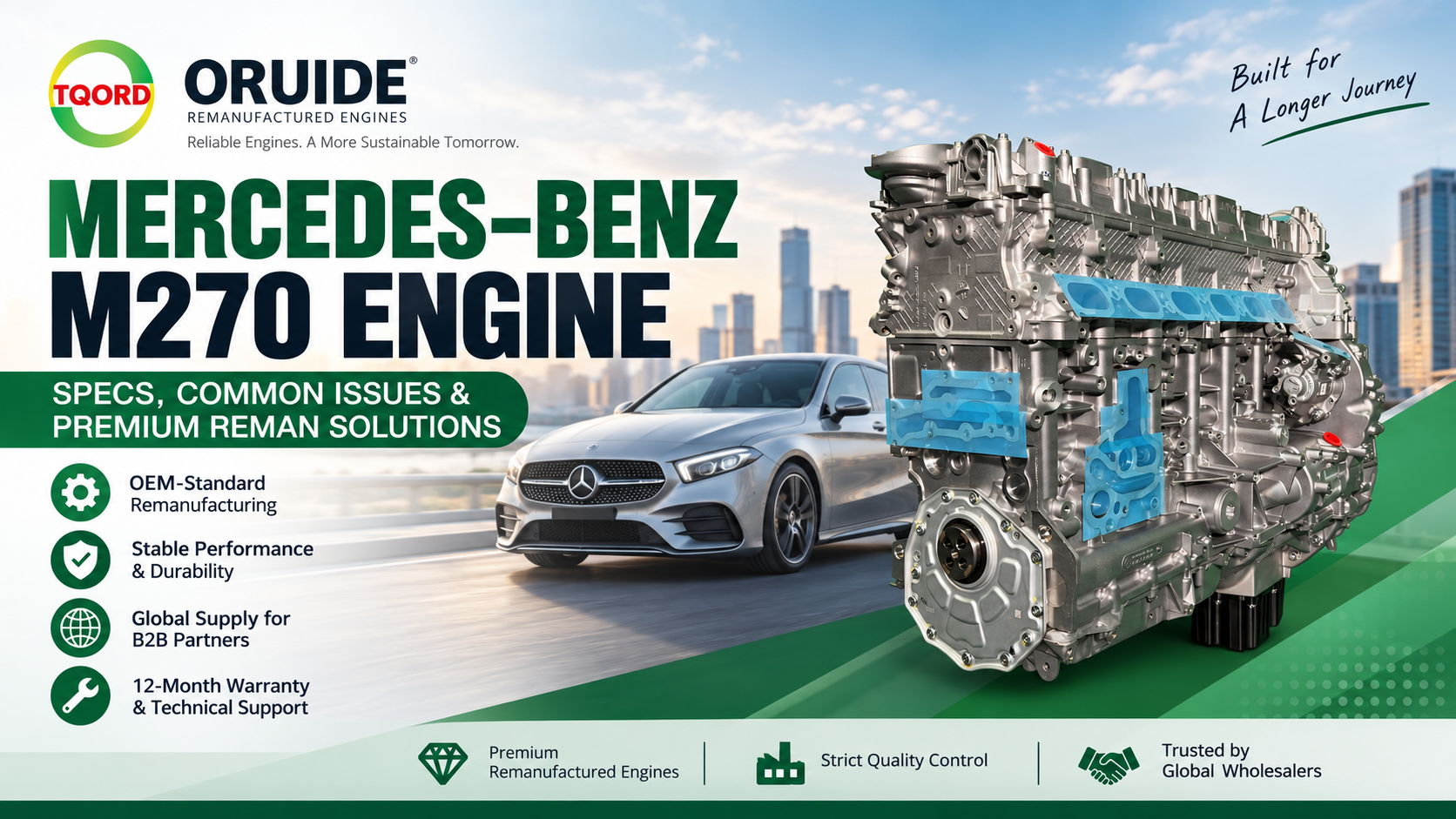
This distinction is particularly important in the replacement-engine market. The M270910 has a displacement of 1,595 cc, while the M270920 has a displacement of 1,991 cc. Both use direct gasoline injection, turbocharging, DOHC 16-valve architecture and chain-driven camshafts, but their displacement, stroke, compression ratio, output and vehicle applications differ.
The M270 is closely related to the Mercedes-Benz M274 engine family, but the two should not be treated as universally interchangeable. The M270 was developed primarily for transverse compact-car applications, whereas the M274 was primarily designed for longitudinal vehicle platforms.
For global auto parts wholesalers, regional distributors and professional repair networks, the M270 remains an important aftermarket replacement engine. As these vehicles accumulate mileage, engine condition becomes increasingly dependent on maintenance history, lubrication, cooling-system condition, timing-system wear and previous operating conditions.
For B2B buyers requiring more consistent replacement-engine quality than ordinary used engines can provide, Oruide supplies professionally remanufactured M270 engines for wholesale, recurring procurement and international export.
Mercedes-Benz M270 Full Technical Specifications
Parameter |
M270910 / DE16 AL |
M270920 / DE20 AL |
Displacement |
1,595 cc (1.6L) |
1,991 cc (2.0L) |
Fuel Type |
Petrol / Gasoline |
Petrol / Gasoline |
Configuration |
Inline-4, DOHC, 16-valve |
Inline-4, DOHC, 16-valve |
Aspiration |
Turbocharged |
Turbocharged |
Bore x Stroke |
83.0 x 73.7 mm |
83.0 x 92.0 mm |
Power Output |
Approx. 75-115 kW (102-156 PS), depending on version |
Approx. 115-160 kW (156-218 PS), depending on version |
Torque |
Approx. 180-250 Nm |
Approx. 270-350 Nm |
Fuel System |
High-pressure gasoline direct injection |
High-pressure gasoline direct injection |
Emissions Standard |
Euro 5 / Euro 6 depending on model year and market |
Euro 5 / Euro 6 depending on model year and market |
Compression Ratio |
Approx. 10.3:1 |
Approx. 9.8:1 |
Cooling System |
Liquid-cooled |
Liquid-cooled |
Turbocharger |
Single turbocharger |
Single turbocharger |
Timing System |
Chain-driven DOHC with variable camshaft timing |
Chain-driven DOHC with variable camshaft timing |
CAMTRONIC |
Available on applicable 1.6L versions; not universal |
Not a universal M270 DE20 specification |
Engine Oil |
Mercedes-Benz-approved oil specification according to vehicle/model year |
Mercedes-Benz-approved oil specification according to vehicle/model year |
Engine Weight |
Varies according to configuration and accessories |
Varies according to configuration and accessories |
For B2B replacement-engine sourcing, these specifications should be treated as family-level reference data. Exact engine code, VIN, vehicle application, model year and destination market should be confirmed before quotation and production.
M270 Engine Compatible Vehicles
Engine Model |
Displacement |
Typical Compatible Vehicles |
M270910 / DE16 AL |
1.6L |
Mercedes-Benz A-Class W176 (A160/A180/A200), B-Class W246 (B160/B180/B200), CLA C117 (CLA180/CLA200), GLA X156 (GLA180/GLA200), depending on market and model year |
M270920 / DE20 AL |
2.0L |
Mercedes-Benz A-Class W176 (A220/A250), B-Class W246 (B220/B250), CLA C117 (CLA220/CLA250), GLA X156 (GLA220/GLA250), depending on market and model year |
The M270 family was primarily designed for Mercedes-Benz's transverse compact-car architecture.
Importantly, M270910 and M270920 are not interchangeable simply because they belong to the same M270 family. In addition to the displacement difference, variations can exist in engine calibration, turbocharger configuration, sensors, accessories, emissions equipment and vehicle installation.
For wholesale or recurring replacement-engine procurement, Oruide therefore recommends confirming the engine code and VIN before final quotation.
Common M270 Engine Failure Points & Root Cause Analysis
Although the M270 is a relatively modern turbocharged gasoline engine, aging and high-mileage units can develop several issues that should be considered during professional engine inspection and remanufacturing.
1. Timing Chain and Timing-System Wear
The M270 uses a chain-driven timing system. On higher-mileage engines, timing-system condition should be inspected carefully, particularly when there is abnormal cold-start noise, timing-related diagnostic trouble codes or evidence of poor lubrication history.
Rather than assuming that every timing-related fault is caused by the chain itself, a professional diagnosis should evaluate the chain, guides, tensioning components, camshaft adjustment system and lubrication condition as a complete system.
During remanufacturing, Oruide inspects these components and replaces worn timing components according to the condition of the individual engine.
2. Direct-Injection Fuel-System Problems
The M270 uses high-pressure gasoline direct injection. Fuel-pressure faults, injector problems or deterioration of fuel-system components can contribute to hard starting, misfires, unstable operation and loss of performance.
However, these symptoms should not automatically be attributed to a single component such as the high-pressure fuel pump. Proper diagnosis should include fuel-pressure testing, injector condition and related engine-management parameters before determining the root cause.
3. Intake Valve Carbon Buildup
Because the M270 uses gasoline direct injection, fuel is delivered directly into the combustion chamber rather than washing over the back of the intake valves.
Over extended operation, deposits can therefore accumulate in the intake tract and on intake valves. Depending on operating conditions, maintenance history and mileage, excessive deposits may contribute to rough idle, airflow restriction or performance deterioration.
During remanufacturing, intake-system and cylinder-head condition should therefore be inspected and cleaned according to actual condition rather than applying the same treatment blindly to every engine.
4. Cooling-System and Lubrication-Related Aging
Cooling-system deterioration, coolant leakage and lubrication problems can become increasingly important as M270 engines age.
An engine that has experienced overheating, inadequate lubrication or prolonged coolant loss may have secondary damage that is not immediately visible during basic inspection.
For this reason, Oruide's failure analysis focuses not only on the visibly damaged component but also on related systems that may have contributed to the original failure.
This root-cause-oriented approach is particularly important for professional engine distributors and repair networks because simply replacing the failed component without addressing the underlying cause can increase repeat-failure and warranty risk.
Oruide Professional M270 Remanufacturing Process & B2B Advantages
Oruide has experience in Mercedes-Benz turbocharged gasoline engine remanufacturing and international B2B engine supply.
For M270 engines, our remanufacturing process begins with complete engine disassembly, cleaning and dimensional inspection.
The cylinder block, cylinder head, crankshaft, connecting rods and other critical components are inspected according to their actual condition. Components outside the required dimensional or functional specifications are machined, repaired or replaced where appropriate.
Particular attention is given to areas associated with the original failure. For engines showing timing-related symptoms, the complete timing system and related lubrication condition are inspected. For engines with overheating history, cylinder-head flatness, sealing surfaces and cooling-related components receive additional evaluation. Fuel-system and intake-related conditions are also assessed where relevant.
Critical wear components - including bearings, piston rings, gaskets, seals and applicable timing components - are replaced according to the remanufacturing specification.
The engine is then assembled under controlled workshop procedures using calibrated torque tools. Critical clearances, tightening specifications and timing alignment are verified during assembly.
Cold-Test Bench Validation
Every completed Oruide remanufactured M270 engine undergoes cold-test bench validation before shipment. For remanufactured engine quality control, cold testing provides an efficient way to verify key mechanical and functional parameters without combustion.
- Oil-pressure generation
- Engine sealing and leakage
- Crankshaft rotational characteristics
- Camshaft-to-crankshaft synchronization
- Relevant sensor signals
- Other functional parameters available during cold testing
The purpose is to identify assembly or functional abnormalities before the engine leaves the factory. After testing, each engine undergoes final quality inspection and export-oriented packaging.
For automotive engine wholesalers, regional distributors and professional repair networks, Oruide supports bulk M270 engine procurement, recurring orders, export packaging, inventory planning and customized B2B cooperation.
This provides professional buyers with a more standardized replacement-engine sourcing option than relying solely on used engines with uncertain maintenance and operating histories.
Frequently Asked Questions (FAQ)
Q1: What is the main difference between M270910 and M270920?
The most fundamental difference is displacement. The M270910 / DE16 AL is a 1.6L engine with 1,595 cc displacement and an 83.0 x 73.7 mm bore and stroke, while the M270920 / DE20 AL is a 2.0L engine with 1,991 cc displacement and an 83.0 x 92.0 mm bore and stroke. Their compression ratios and output ranges also differ. They should therefore not be treated as universally interchangeable.
Q2: Is the M270 the same engine as the M274?
No. The M270 and M274 are closely related engine families and share a number of technologies, but their intended installation layouts differ. The M270 was developed primarily for transverse compact Mercedes-Benz platforms, while the M274 was mainly used in longitudinal applications. For replacement-engine procurement, M270 and M274 should therefore not be selected based solely on displacement or appearance.
Q3: Can Oruide provide bulk wholesale and export services for remanufactured M270 engines?
Yes. Oruide supports recurring and bulk remanufactured-engine procurement for professional B2B customers including automotive engine wholesalers, parts distributors and repair networks. Export-oriented packaging, engine configuration verification, inventory planning and technical support can also be provided according to customer requirements.
Q4: What information should I provide when requesting an M270 engine quotation?
For preliminary sourcing, provide the required engine code, vehicle model, model year, destination market and estimated quantity. For final configuration verification, Oruide recommends providing the VIN whenever possible. This reduces compatibility risk and allows the exact engine configuration to be checked before production and shipment.
Q5: Is a remanufactured M270 suitable for fleet and repair-network procurement?
For professional buyers, the relevant comparison is between the condition consistency, testing process, warranty requirements and supply stability of the available replacement options. Oruide remanufactured M270 engines undergo disassembly, inspection, component evaluation, controlled assembly and final cold testing, making them suitable for B2B buyers seeking a standardized process for recurring replacement-engine procurement.
Ready to source high-quality remanufactured engines from a reliable engine supplier? Fill out our form to get a customized quote within 24 hours. We’ll help you select the right engine model, confirm MOQ, and outline delivery timelines, so you can source with confidence.